If you are completely new to biology olympiads, here is the honest starting point: the British Biology Olympiad (BBO) is a short online exam — no lab — that rewards applying biology to unfamiliar problems rather than reciting facts. Build a solid A-level/AP-style foundation across its seven syllabus areas first, then practise with past questions. There is no shortcut, but there is a clear order.
This guide is written for the student who has never sat an olympiad and feels behind. You are not. Most strong BBO scorers started exactly where you are. Below is the foundation to build, the order to build it in, and what “realistic” actually looks like in your first season.
What the BBO is — and why beginners can do well
The BBO is organised by UK Biology Competitions (UKBC) and the Royal Society of Biology, a registered charity. It is aimed at sixth-form / high-school students with a strong interest in biology, and it is deliberately designed to reward thinking, not memory. Last year, more than 15,000 students from over 900 schools took part — so this is a mainstream, accessible entry point, not a closed club for specialists.
The exam is entirely online with no practical/lab component. You will meet three question formats: multiple-choice, fill-in-the-blank, and ordering (sequencing) questions. That format matters for beginners: you are never asked to write a long essay or run an experiment. You are asked to read a short, often unfamiliar scenario and reason from biological principles you already understand. For the exact paper structure, timing, and any year-specific rules, check our competition rules page and always confirm current details on the official BBO channels.
Step 1 — Build the foundation before you touch a single past paper
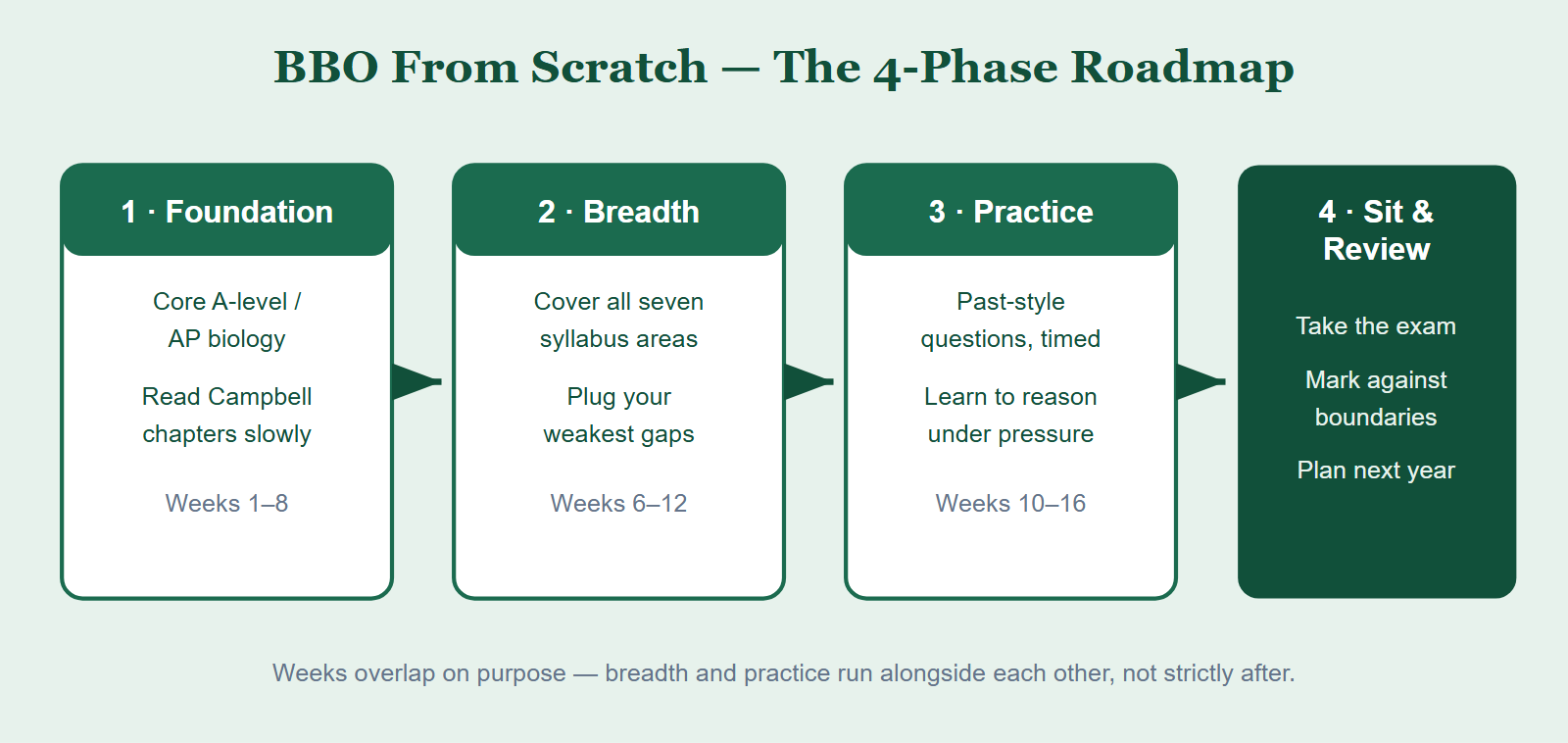
The most common beginner mistake is jumping straight into olympiad questions and feeling crushed. The BBO maps onto a strong A-level or AP biology course plus some first-year university material. If your school biology is shaky, no amount of “olympiad technique” will rescue you — the technique has nothing to stand on.
The standard text is Campbell Biology, supplemented by your AP or A-level resources. You do not read it cover to cover in a panic. You read the chapters that map to the seven syllabus areas, slowly, making sure you can explain each idea in your own words. If you can teach a concept to a classmate without notes, you own it. If you can only recognise it, you do not yet.
Step 2 — Cover all seven syllabus areas (and find your weakest)
The BBO is built on seven core areas. A beginner’s instinct is to deepen the topics they already like. Resist it. Olympiad questions are unpredictable, and the cheapest points to gain are in the areas you have been avoiding.
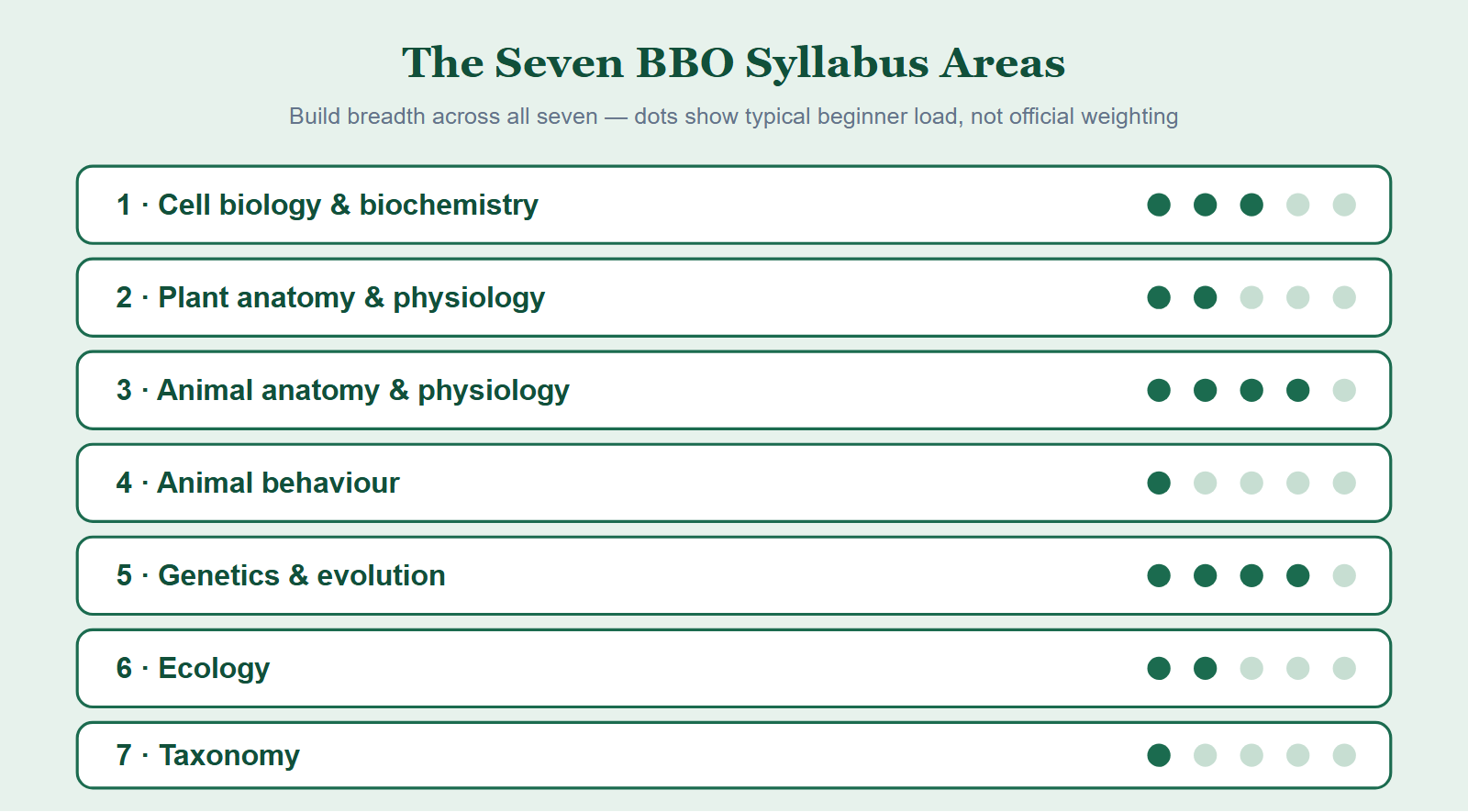
Animal physiology and genetics/evolution tend to carry the most demanding questions for newcomers, so give them extra runway. But taxonomy and animal behaviour, which beginners often skip, are exactly where a little revision turns into easy marks. The point of covering all seven is not encyclopaedic mastery — it is to never be blindsided.
Step 3 — Practise the way the exam actually works
Once your foundation is in place, switch to practising. Work through questions under timed conditions so the format stops feeling alien. For multiple-choice you learn to eliminate; for fill-in and ordering you learn to commit. The skill being trained is not recall — it is reading a novel scenario calmly and asking, “Which principle from my foundation explains this?”
We maintain a collected free pack of BBO past papers to practise with — scan the QR code on this site or message us to get it. (Worked-solution coverage varies by year, and our teachers add more over time.) Frame these as practice fuel, not a magic answer key: a paper you cannot yet explain is a list of topics to revise, not a score to memorise. You can also browse our past papers hub for how to use them.
What “realistic” looks like in your first season
Awards are decided by your score against published boundaries — Gold, Silver, Bronze and further tiers such as Highly Commended and Commended. As a rough guide, 2024 boundaries sat near 113 for Gold, 103 for Silver, and 96 for Bronze, but boundaries change every year, so confirm the current ones on the official channels. You are not competing for a fixed number of medals against other students; you are clearing a bar.
For first-timers from our own programme, the bar is very reachable with honest preparation. In the 2026 season, the Hanlin biology cohort earned 26 BBO Golds, 21 Silvers and 5 Bronzes (per our own records), and 5 students went on to reach the USABO US-region Semifinal. The takeaway for a beginner is not “everyone gets gold” — it is that a structured foundation, not raw talent, is what moves the needle.
One realistic-expectations note on what the BBO leads to. International and China-region students take part for BBO recognition; the BBO selects the UK’s International Biology Olympiad (IBO) team through a separate UK-based path, so an international student’s goal is the award and the learning, not the UK IBO squad. For exactly who is eligible for which exam and how registration works, see our China-region exam guide and confirm on the official BBO channels.
Looking ahead: the BBO is a launchpad
Here is a genuinely useful piece of planning insight. The BBO and the USA Biology Olympiad (USABO) share roughly 90% of their content, and USABO sits in late March — after the BBO. That means the foundation you build now is not single-use. A student who prepares properly for the January BBO is already most of the way to a strong USABO attempt weeks later. Many of our highest performers treat the two as one continuous season rather than two separate mountains. If that path interests you, read how the BBO sets up a USABO run, and for a fuller study plan see our complete BBO preparation guide.
Start with the foundation. Cover all seven areas. Practise under time. Review honestly. Do those four things in order and the BBO stops being intimidating and starts being a roadmap you are already walking.
Frequently asked questions
I’ve never done a biology olympiad. Am I too far behind to start the BBO?
No. The BBO is built for sixth-form / high-school students with a strong interest in biology, and it rewards reasoning over memorised facts. With a solid A-level or AP foundation and a few months of structured practice, beginners regularly earn award tiers. Start with the foundation, not with past papers.
How long does it take to prepare for the BBO from scratch?
There is no official answer, and it depends on your starting biology level. A realistic plan spends the first several weeks building core A-level/AP biology, then runs breadth and timed practice alongside each other over the following weeks. Quality of understanding matters more than total hours — confirm exam dates on the official channels and work backwards from them.
Do I need to do experiments or lab work for the BBO?
No. The BBO is a short online exam with no lab component. Questions are multiple-choice, fill-in-the-blank, and ordering, so your preparation is reading, understanding, and timed practice — not practical skills.
What book should a beginner use?
The standard text is Campbell Biology, supplemented by your AP or A-level resources. Read the chapters that map to the seven syllabus areas and make sure you can explain each idea in your own words before moving to practice questions.
This is an independent English-language guide to the British Biology Olympiad for international and China-region students, operated by Hanlin Education. It is not affiliated with, endorsed by, or sponsored by UK Biology Competitions (UKBC) or the Royal Society of Biology. Rules, dates, eligibility and results are set by the organiser — always confirm current details through the official BBO channels.