
Mentioning the British Biology Olympiad on a UCAS personal statement only works if you turn it into evidence, not a name-drop. Admissions tutors for biology, biomedical science and medicine value what the BBO shows about how you think — your independent reading, analytical habits and genuine subject curiosity. This guide explains how to write about the BBO so it reads as substance, whatever award you achieved.
What the BBO signals to a UK admissions tutor
The BBO is a short, timed online exam for sixth-formers that reaches beyond the standard syllabus, so entering it signals initiative and academic stretch. But a tutor cannot tell from a certificate line what you actually learned. The value comes from what you did with the experience: the topics you read around, the way you approached unfamiliar data questions, and the scientific habits you built. Those are the things a personal statement can evidence in a way a grade cannot.
This matters most for competitive courses. If you are applying to biology, biochemistry or biomedical programmes — particularly at research-intensive universities — the statement is where you demonstrate that your interest is real and self-driven. We discuss the broader admissions rationale in our companion piece on why the BBO suits Commonwealth-track applicants; here we focus purely on the writing.
The reflection framework: from activity to evidence
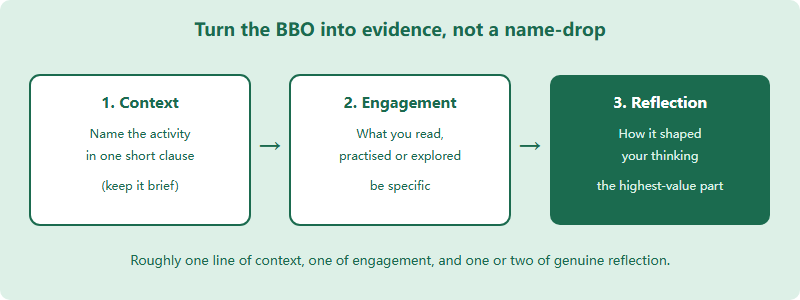
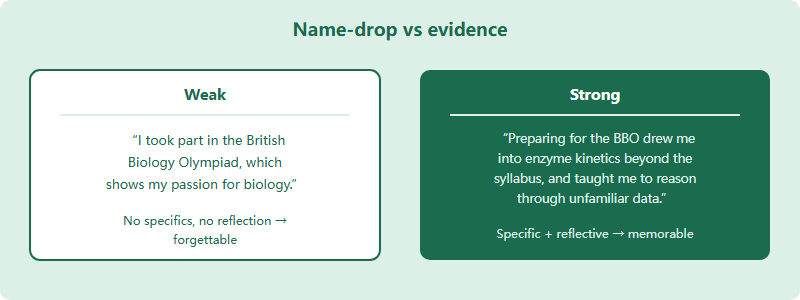
Weak statements say “I took part in the BBO.” Strong statements show a chain: what you did, what you learned, and how it shaped your thinking. Use a simple three-part move for any olympiad sentence.
| Move | What it does | Weak version vs strong version |
|---|---|---|
| 1. Context | States the activity briefly | “I entered the BBO” → keep this to a clause, not a sentence |
| 2. Specific engagement | Shows what you actually did | “…which pushed me to read beyond the A-Level syllabus into enzyme kinetics and photosynthesis mechanisms” |
| 3. Reflection | Links it to how you think or your intended course | “…and taught me to reason through unfamiliar data rather than rely on recall — the mindset I want to develop in a biology degree” |
The reflection is where marks are effectively won in an application. A tutor reading hundreds of statements is looking for the candidate who can articulate why an experience mattered intellectually — not simply that it happened.
Writing it well whatever your result
A common worry is whether the BBO is worth mentioning without a top award. It usually is — because the honest reflection is what counts, not the tier. Adapt your framing:
- If you achieved a high award — you may reference it briefly, but still lead with what you learned, not the label.
- If you achieved a middle award or a commendation — focus entirely on the reading and reasoning it prompted; the intellectual engagement is the evidence.
- If you entered without a distinction — frame it as a stretch challenge that exposed you to university-level ideas and sharpened your independent study. Sitting a demanding exam is itself initiative.
Under UCAS's current guided-question personal-statement format, one of the sections asks about preparation beyond your qualifications — a natural home for an olympiad. But confirm the exact prompts and structure on the official UCAS site, as these details change between cycles.
Pitfalls that weaken an olympiad mention
Several common mistakes turn a promising point into filler:
- The bare name-drop — listing the BBO with no reflection wastes precious characters.
- Overstating the outcome — never inflate an award or imply it guarantees anything; tutors read carefully and value honesty.
- Generic claims — “it made me passionate about biology” says nothing. Name the specific idea that gripped you.
- All context, no thinking — describing the format of the exam instead of what you took from it.
- Ignoring the wider picture — the strongest statements connect the BBO to other reading, an EPQ, or lab experience to show a coherent scientific interest.
Build the evidence before you write
The best time to make the BBO usable in an application is while you prepare for it. Keep a short log of topics that surprised you, questions that stretched your reasoning, and any wider reading a problem sent you toward. That log becomes the raw material for a specific, honest paragraph months later.
This is also where planning your competition sequence pays off. Students who follow a structured route — for example, sitting the BBO and then progressing toward the USA Biology Olympiad — accumulate a richer, more coherent story of scientific commitment, which our BBO-then-USABO double-gold plan lays out. If you have not entered yet, our China-region exam guide explains how the exam works, and our preparation guide covers the content — the deeper your genuine engagement, the more you will have to write about.
Frequently asked questions
Is it worth mentioning the BBO without a top award?
Usually yes. Admissions tutors value the reflection and independent reading it prompted more than the specific award tier.
Where does the BBO fit in a UCAS personal statement?
It suits the section on preparation and wider engagement beyond your qualifications, but confirm the current prompts on the official UCAS site.
Can the BBO guarantee a place at a top university?
No — no single activity guarantees admission. It is one piece of evidence of scientific thinking within a stronger overall application.
How much space should I give it?
Typically a few well-chosen lines. Depth of reflection matters far more than length or listing every detail.
This is an independent guide operated by Hanlin Education for China-based international-school students. It is NOT affiliated with, endorsed by, or sponsored by the UK Biology Competitions (UKBC) or the Royal Society of Biology. Official competition administration is handled by the organiser; always confirm current dates, format and rules on the UKBC official pages. Any factual error will be corrected within 7 working days.