
The British Biology Olympiad is sat in January, which at most international schools in China is the single most congested fortnight of the year. Worse, the decision to enter is not made in January at all. Your school has to register before the entry deadline, which in our own operations has fallen in early January, so the commitment is made weeks before you feel ready and usually while nobody is thinking about it.
The decision is usually made long before the exam week
Only a recognised educational institution can enter students for the olympiad. Individuals cannot register themselves, and neither can tutoring companies or online-only providers. In practice that means someone at your school — a biology teacher, a head of department, an exams officer — has to have put your name on a list before the deadline passes.
That single administrative fact reshapes the whole autumn. The point at which you can still choose to sit the paper is not the week of the exam. It is whenever your school closes its internal list, which is necessarily earlier than the organiser's own entry deadline, because the school needs time to collect names, confirm arrangements and handle payment. In our experience the school-side cut-off falls well before the organiser’s deadline, in the middle of end-of-term assessments, when a Year 12 student has no idea yet whether they will be ready and a Year 13 student is buried in applications.
So the honest sequence is: you commit weeks before the paper, you find out whether you were ready in mid-January, and little in between is under your control. Ask your school for its internal cut-off and check the organiser’s published registration arrangements for the season. Everything in this article follows from taking that seriously.
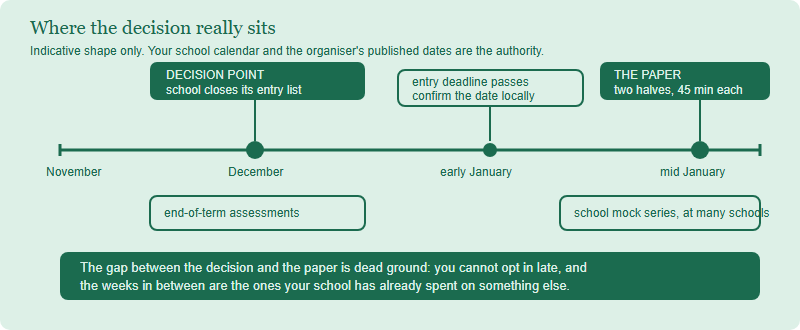
What mid-January already contains
Before adding an olympiad to that fortnight, write down what is already in it. At a typical international school in China, some version of the following is competing for the same days.
| What lands in the same window | Why it collides | Can you move it? |
|---|---|---|
| January mock examinations | Full-length papers across several subjects, often used to inform predicted grades | No. Treat as fixed. |
| End-of-semester internal assessments and reports | Coursework and project deadlines cluster before the break | Rarely. Sometimes a few days. |
| IB internal assessment or coursework checkpoints, where applicable | Draft deadlines are set by your school and are usually immovable | No. |
| Year 13 application follow-up: interviews, admissions tests, offer replies | Externally timed, high stakes, unpredictable | No. |
| The Spring Festival holiday, when it falls early | Compresses the whole January teaching period | No. But you can see it coming. |
| The olympiad itself | Ninety minutes of exam plus the days you would want either side of it | Only by choosing not to enter |
The conclusion most students resist is the useful one: the last genuinely productive olympiad revision of your season happens in December. January belongs to your school. Any preparation plan that assumes a big final push in the first two weeks of January is planning to use time that is already spoken for, which is why we front-load the autumn in our preparation guide rather than saving intensity for the end.
One lever you probably have, and one you definitely do not
You cannot move the competition. But the format contains a small amount of give that many students never ask about. UKBC describes the olympiad as two papers of forty-five minutes each, taken online at your registered school under teacher supervision, and states that the two can be completed together or separately. The competition also runs across a window of days rather than a single fixed hour worldwide.
What that means in practice at your school — which day, whether the two halves run back to back or on separate mornings, which room, which devices — is not something you can read off a webpage. It is a question for whoever is organising the entry, and it is worth asking politely and early, in November rather than in January. Two halves run back to back is a cleaner single hit on your week. Two halves split across separate days costs you two disrupted mornings but leaves you fresher for each. Neither is obviously better; what is bad is finding out the arrangement the day before.
Two other things to raise in the same conversation. If you have an approved arrangement for extra time at school, ask early whether and how it applies here, since the organiser makes proportional extra time available for eligible students but the administration sits with your school. And confirm the room and device set-up, because an online paper sat on-site has failure modes that a paper exam does not. The wider practicalities of sitting through a school in China are set out in our China-region exam guide.
A sit-or-skip rule, mostly for Year 13
For a Year 12 student the answer is nearly always to enter. The cost is one morning, the paper is a genuine diagnostic, and there is a second bite next year. Year 13 is where the collision bites, because January is also when applications turn into interviews, tests and decisions. Work through these in order.
- Is anything in your January already externally timed and high stakes? An admissions interview or a required test outranks an optional olympiad. If the dates clash directly, that is the end of the discussion.
- Is your January mock series being used for predicted grades or offer conditions? If yes, it has a claim on your revision hours that the olympiad does not.
- Have your applications already gone in? If the paper will be sat after your forms are submitted, an award arrives too late to appear on them, and the honest reason to enter becomes the biology itself, plus a spring competition it can feed into. That is a good reason, but it should be the one you are actually choosing.
- Did you sit it in Year 12? If you did and you want a better result, the case is stronger, because you already know the format and the marginal preparation cost is much lower.
- What is the realistic upside? Award bands sit only a few marks apart in the middle of the scheme, so a compressed, distracted preparation is quite likely to land you in the same band as last year rather than a higher one.
Skipping is a legitimate answer. What is not legitimate is drifting: entering because it was easier than saying no in December, then arriving in January with no preparation and calling the result a measure of your ability. That is the outcome the whole decision is meant to avoid.
Protecting the fortnight: a fourteen-day protocol
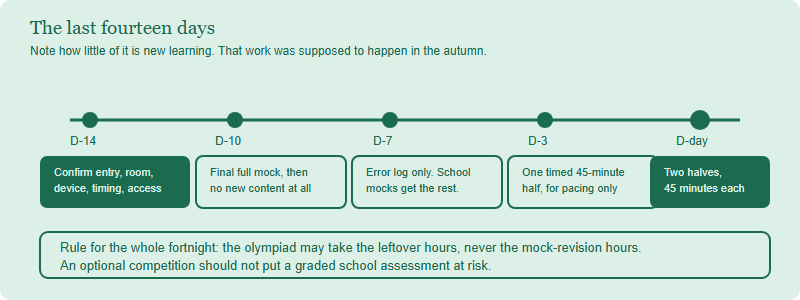
The reason the protocol is so sparse is the collision itself. In a normal competition run-up you would ramp intensity toward the exam. Here you cannot, because the same days are carrying mocks and deadlines that have real consequences for your school record. Cramming biology in the week of your mocks is a bad trade in both directions: it will not add much to the olympiad and it can cost you real marks elsewhere.
One more reason to keep January light. If you are planning a second olympiad paper in the spring, the ten weeks after January are far better spent than the two weeks before it, because they are relatively empty and you will by then know exactly what your errors look like. That sequencing is the whole idea behind our BBO then USABO plan.
The Spring Festival variable
One planning factor that a UK-written calendar cannot show you: the Spring Festival holiday moves, swinging between late January and the second half of February depending on the year. In seasons when it falls early, the January teaching period is compressed at both ends, mock series get pulled forward, and the fortnight described above becomes tighter still. In seasons when it falls late, January is comparatively roomy.
Do not guess at this. Open your school's published calendar for the coming academic year in September, mark the holiday, mark your mock series, and mark the approximate olympiad window from the organiser's pages once the new-season dates are published. Ten minutes in September prevents the specific unhappiness of discovering in December that your school's entry list closed the week you were on a term break.
Frequently asked questions
When does my school need to enter me?
Ask your biology teacher now. Schools close internal lists before the official deadline; confirm both dates on the UKBC official pages.
Can the two forty-five minute papers be taken on different days?
UKBC states they can be completed together or separately. How your school arranges it is a question for your exams officer.
Should a Year 13 student skip the BBO in a heavy January?
If it clashes with an admissions test, interview or grade-bearing mock, skipping is reasonable. Drifting into it unprepared is not.
How much revision should the final fortnight hold?
Very little new content. Confirm logistics, take one final full mock early, then work only from your error log.
This is an independent guide operated by Hanlin Education for China-based international-school students. We are not affiliated with, endorsed by, or sponsored by UKBC or the Royal Society of Biology, and official administration of the competition rests with the organiser. Timings described from our own operations are indicative and new-season dates were not confirmed at the time of writing; confirm the current competition window, entry deadline and format on the UKBC official pages and with your school. Errors reported to us are corrected within 7 working days.