
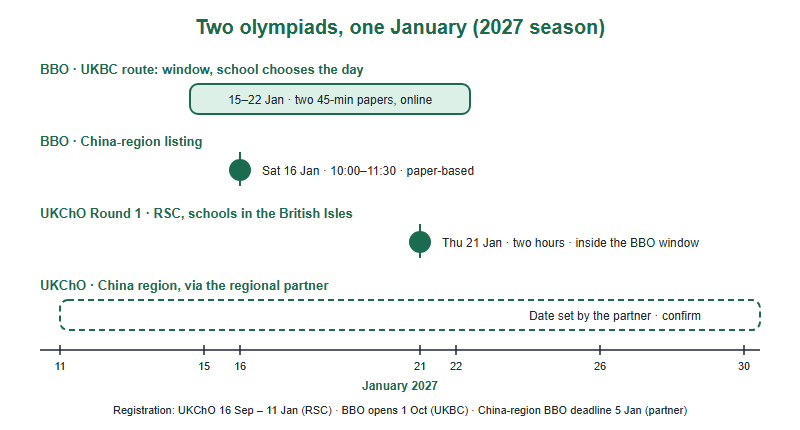
Yes, you can prepare for the British Biology Olympiad and the UK Chemistry Olympiad in the same season — but they are separate competitions, entered separately, sat days apart in January, and built on very different formats. The RSC lists UKChO Round 1 for schools in the British Isles on Thursday 21 January 2027, which falls inside UKBC's BBO window of 15–22 January. Plan the pair as one project, not two.
Why this pairing comes up every September
Many students we teach who are heading for medicine, biochemistry, biomedical science or natural sciences take Biology and Chemistry together, at A-Level, IB Higher Level or an equivalent. Both subjects have a January olympiad run by a UK organisation: the BBO, run by UK Biology Competitions, and the UK Chemistry Olympiad, run by the Royal Society of Chemistry. So the question arrives every autumn: one, the other, or both?
The timing makes it urgent now. The RSC lists UKChO registration as Wednesday 16 September 2026 to Monday 11 January 2027, so that window is already open. UKBC states that BBO registration opens on 1 October. In both cases a school registers you, not you personally, which means the conversations with your biology and chemistry teachers need to happen in the next few weeks rather than in December.
Neither organiser's page restricts entering the other competition; they simply do not reference each other. That is the point of this article. Nobody is going to coordinate the two for you.
The two competitions, side by side
| Detail | British Biology Olympiad | UK Chemistry Olympiad (Round 1) |
|---|---|---|
| Organiser | UK Biology Competitions (UKBC) | Royal Society of Chemistry (RSC) |
| Format | “Two, 45-minute multiple choice papers” online at school, per UKBC; the China-region listing describes one 90-minute paper-based multiple-choice sitting | A written test of real-world chemistry problems; “The Round One paper lasts two hours”, per the RSC |
| 2027 date, UK route | A window of 15–22 January; the registered school chooses when | Thursday 21 January 2027, sat at school under exam conditions |
| 2027 date, China region | Saturday 16 January 2027, 10:00–11:30, per the regional partner's listing | Set by the same regional partner; confirm the current date with them or your school |
| Registration | Opens 1 October (UKBC); China-region deadline 5 January 2027 (partner listing) | 16 September 2026 – 11 January 2027 (RSC); China-region deadline per the partner |
| Who enters you | Your school: recognised institutions only, not individuals or tutoring companies (UKBC) | Your school; the RSC states international schools in China “should register through ASEEDER China” |
| Worth knowing | Both papers must be completed to be considered for an award (UKBC) | Round 1 marking runs 22 January – 7 February 2027; 25–30 students go on to Round 2 (RSC), while the RSC describes international schools in China as able to enter Round 1 |
Two lines in that table decide most of the planning. First, the formats are opposites: one rewards quick, accurate selection across a broad biology paper, the other rewards two hours of sustained written working on multi-part chemistry problems. Second, on the UK route the chemistry date sits inside the biology window, while on the China-region route the BBO comes first and the chemistry sitting is scheduled separately by the regional partner.
On that last point, a caution. The China-region UKChO date for 2027 has been updated at least once during this season, according to notices shared through our organising channels, and a date on one page may lag behind a newer notice. We are deliberately not printing a single date here. Ask your school which date it is working to, and check it again after you register.
The shared ground: one biochemistry block, counted twice
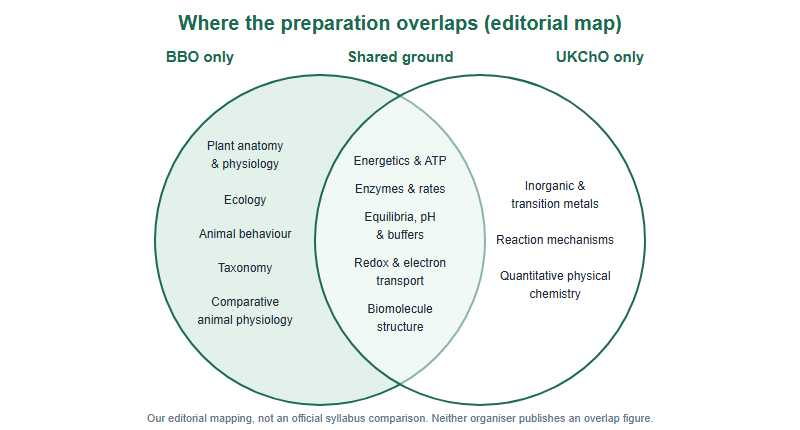
The honest case for doing both is not that they are the same exam. It is that a substantial middle band of material is the same science described in two vocabularies. A biology student meets enzyme kinetics as “rate of reaction against substrate concentration”; a chemistry student meets the same curve as kinetics and equilibrium. Respiration is redox chemistry. Blood pH is a buffer problem. Amino acids and sugars are stereochemistry.
If you revise that band once, deliberately, from both directions, it pays into both papers. If you revise it twice under two different names, you lose weeks. In our teaching groups, the students who handle both competitions best build this shared block first, in late September and October, before either subject pulls them into its own territory.
Two formats, two different kinds of practice
The shared content does not mean shared practice. The formats train different muscles, and a student who practises only one will feel it on the other day.
- For the BBO, the unit is 45 minutes of multiple choice. UKBC describes the organiser's paper as “not primarily a test of knowledge”, built around unfamiliar topics solved with basic principles. Practise in 45-minute blocks, across all seven content areas, with speed and elimination as the skills under test.
- For UKChO, the unit is two hours of written working. The RSC describes a written test of real-world chemistry problems, and the regional partner's listing describes around five or six analysis problems of several parts each. Practise in long, uninterrupted sessions where you show the full chain of working, because the skill under test is staying accurate through a multi-step problem.
- Alternate, do not blend. A workable rhythm from November is one timed BBO block and one long chemistry problem session each week, with the shared biochemistry material reviewed in between. Blending them into one “science practice” session tends to shortchange the chemistry, because two hours of problems will not fit into an evening of mixed revision.
For the biology half, our BBO preparation guide lays out the seven areas and a study order. For the chemistry half, our sister site's guide to what the UK Chemistry Olympiad is covers the competition from the chemistry side.
Sit both, or choose one?
Doing both is not automatically better. Two rushed results rarely say more than one well-prepared one. Work through these in order.
- Do you take both subjects at an advanced level? If Chemistry is not one of your main subjects, UKChO is a long way to stretch; the partner listing describes it as requiring A-level or equivalent chemistry applied to new problems. Choose the BBO and keep your autumn.
- Is one subject clearly your stronger? Then that competition is your priority, and the other is optional. A strong result in your better science is worth more than two average ones.
- Does your January already hold an interview or admissions test? An externally timed, high-stakes date outranks an optional olympiad. Year 13 students especially should check this before committing to two.
- Can you protect time for both formats every week from November? If the honest answer is no, pick one. Preparation split too thin shows up on both papers.
If all four answers point the same way, sit both — and remember the one rule that makes a clash expensive on the biology side: UKBC states that both BBO papers must be completed to be considered for an award. If your school schedules the BBO inside the UKBC window, ask that neither BBO paper fall on the same day as your UKChO sitting — 21 January for schools in the British Isles, or whichever China-region date your school confirms — so two hours of chemistry are never followed by the second half of your biology entry.
How the pair reads inside an application
For medicine, biochemistry and natural sciences, admissions readers look at how the pieces of a file support each other. A biology olympiad result sits next to your biology grades; a chemistry result sits next to your chemistry grades; your personal statement or essays explain what you did with both. When a BBO award and a UKChO award appear in the same season, each consistent with strong grades in that subject, they cross-check each other: the file shows strength in both sciences, measured by two different external papers, not a single good day.
That is also why the order of priorities above matters. A result that contradicts your grades in the same subject invites a question; a result in your stronger science reinforces what the transcript already says. Nothing here is guaranteed, and no single award decides an application. What a well-chosen pair does is make the rest of your file easier to believe.
If you are sitting the BBO through the China-region route, our China-region exam guide covers how that entry works. And if you are thinking about a spring biology olympiad as well, map the whole year first: the BBO-then-USABO plan is a sequence in time, while BBO plus UKChO is breadth in the same month, and very few students should attempt all three without a careful look at their calendar.
Can I take the BBO and the UKChO in the same year?
They are separate competitions with separate school registrations; neither organiser's page restricts entering the other. Confirm with your school.
When does UKChO registration open for 2027?
The RSC lists 16 September 2026 to 11 January 2027. UKBC states BBO registration opens on 1 October.
Are the BBO and UKChO both multiple choice?
No. UKBC describes the BBO as multiple-choice papers; the RSC describes UKChO Round 1 as a two-hour written problem paper.
Which should I prioritise if I can only do one?
The one in your stronger subject that fits your intended course. One well-prepared result says more than two rushed ones.
This is an independent guide operated by Hanlin Education for China-based international-school students. We are not affiliated with, endorsed by, or sponsored by UKBC or the Royal Society of Biology, nor by the Royal Society of Chemistry; official administration of each competition rests with its organiser. Dates, formats, registration routes and deadlines are set by the organisers and regional partners and change between seasons — confirm current details on the UKBC official pages, the RSC's pages and with your own school before acting. Errors reported to us are corrected within 7 working days.