
For a medicine or pre-med applicant, the British Biology Olympiad (BBO) is usually worth sitting — not because a medal guarantees a place (it never does), but because a strong score is a credible, externally-verified signal that you can apply biology to unfamiliar problems under time. That is exactly the aptitude medical schools screen for. Treat it as evidence, not a golden ticket.
What a BBO result actually signals to admissions
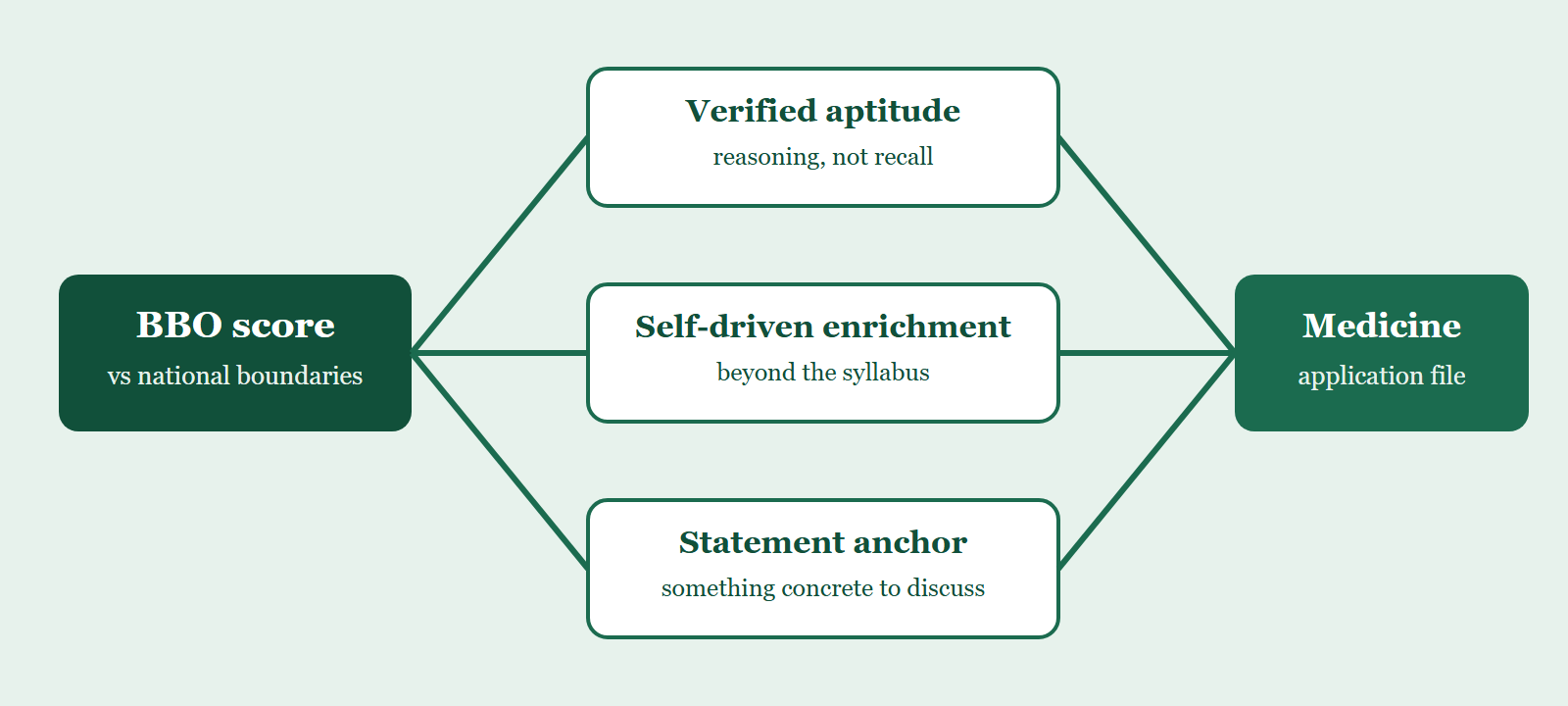
Medical and pre-med admissions are crowded with applicants who all have top grades and the same “I shadowed a doctor” lines. What is scarce is independently verified academic aptitude in the subject that underpins medicine. The BBO — organised by UK Biology Competitions (UKBC) / the Royal Society of Biology, a registered charity — rewards applying biology to unfamiliar problems rather than rote recall. A score against published national boundaries is therefore something an admissions tutor can read at a glance and trust, because you did not set the bar yourself.
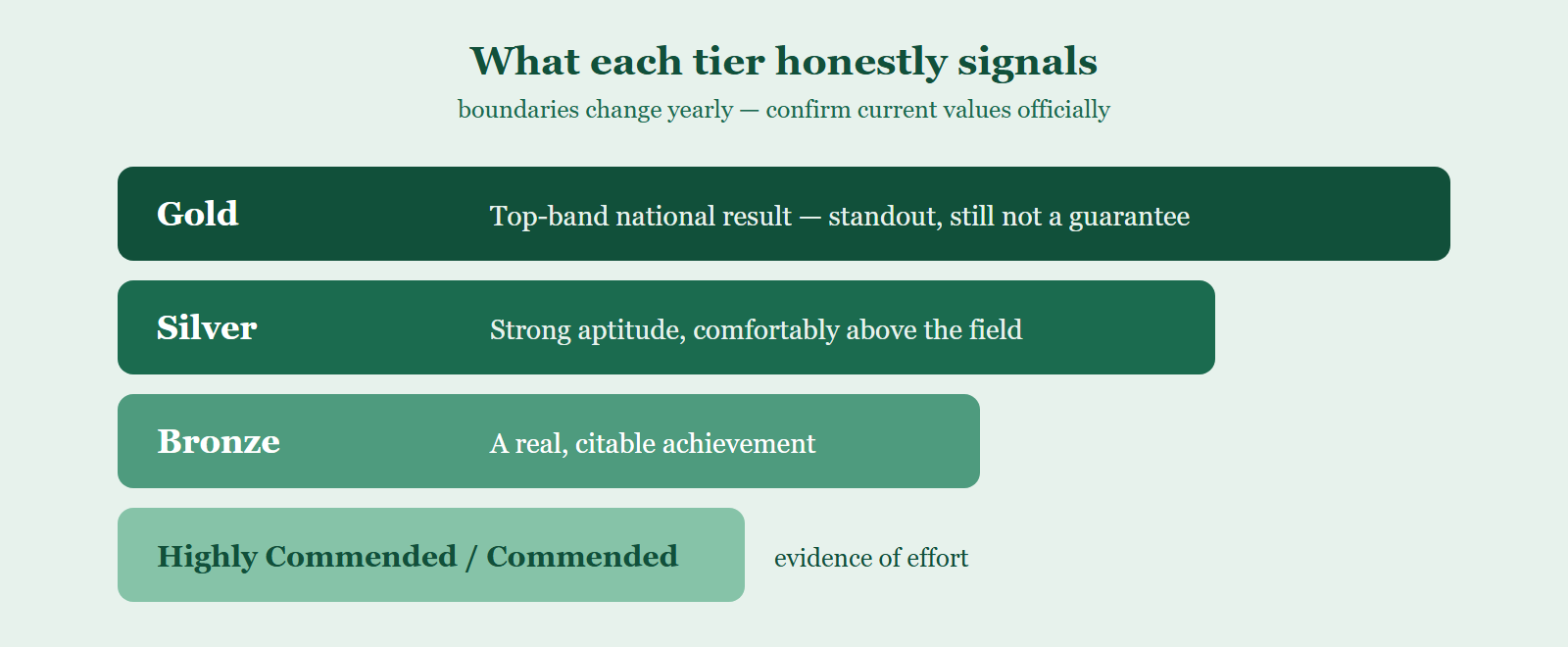
Concretely, a Gold or Silver tells a reader three things at once: you went beyond the syllabus voluntarily, you can reason under exam pressure, and your interest in biology is real enough to test in a national field. Last year 15,000+ students from 900+ schools took part, so a high placement carries genuine information. None of that promises an offer — but it is a real, hard-to-fake data point in a file full of soft ones.
How hard is it, and is the difficulty the point?
The BBO is a short online exam with no lab component; question types are multiple-choice, fill-in, and ordering. Its seven core syllabus areas — cell biology; plant anatomy & physiology; animal anatomy & physiology; animal behaviour; genetics & evolution; ecology; taxonomy — map onto strong A-level or AP biology plus some first-year university material. So the content is reachable; the challenge is depth and speed, not obscurity.
Awards are set by score against published boundaries: Gold, Silver, Bronze and further tiers such as Highly Commended and Commended. As a rough guide, the 2024 boundaries sat around 113 for Gold, 103 for Silver and 96 for Bronze — but boundaries move every year, so confirm the current boundaries on the official channels. For a medicine file this tiering is a feature: even a Bronze or Commended is a legitimate, named achievement you can cite honestly, and reaching for Gold pushes your biology well past what a typical applicant covers.
Where it sits in a realistic medicine plan
Be clear-eyed about weighting. A medicine application is carried by your grades, your admissions test, your personal statement and your interview. The BBO is a supporting credential — it strengthens the academic-aptitude and super-curricular parts of that file, and it gives you a specific, examinable thing to write about and discuss rather than a generic claim of “passion for science.” If sitting it would cannibalise the time you need for the things that actually decide the outcome, that is a bad trade. If it sharpens your biology and gives you a concrete story, it is a good one.
There is also useful leverage for serious applicants: the BBO and the USA Biology Olympiad (USABO) share roughly 90% of content, and the USABO sits in late March. One preparation cycle can realistically target both, doubling the evidence from a single body of study — we walk through that sequencing in our BBO-then-USABO double-gold guide. One honesty note for international applicants: the BBO selects the UK’s International Biology Olympiad (IBO) team via a separate UK-based path, so international students take part for BBO recognition, not for the UK IBO team. How registration and results work for your region should be confirmed on the official BBO channels; we cover the China-region context in our international and China-region exam guide.
How to make the result count (and how to prepare)
A medal you cannot talk about adds little. The applicants who get value from the BBO do two things: they prepare properly against the real syllabus, and they connect the result to medicine in their statement — not “I won a Gold,” but “working the genetics and physiology sections taught me X, which is how I think about Y.” The standard preparation text is Campbell Biology, supported by AP or A-level resources, and timed practice on real past-style questions; our step-by-step plan is in how to prepare for the BBO.
Past papers are the single best way to calibrate difficulty and pace. We keep a collected free pack of BBO past papers — scan the QR or message us to get it; worked-solution coverage varies by year, and our teachers add more over time. You can also start from our past-papers page. For the exact rules and timing, defer to the organiser — see the official rules and confirm the current cycle, with our summary at competition rules.
For context on what a focused cohort achieves: in the 2026 season, Hanlin’s biology cohort earned 26 BBO golds, 21 silvers and 5 bronzes, and five students reached the USABO US-region Semifinal (per Hanlin’s own records). Results vary by student, and these figures are ours, not the organiser’s — but they show what a disciplined preparation cycle can produce when the result is then put to work in an application.
Frequently asked questions
Does a BBO medal guarantee a place at medical school?
No. Nothing does. A strong BBO result is verified evidence of biology aptitude and super-curricular drive, which strengthens your file — but grades, the admissions test, your personal statement and your interview decide the outcome.
Is the BBO worth it if I only get a Bronze or Commended?
Usually yes. Every tier is a named, honestly citable achievement, and the preparation itself deepens your biology. What matters most is that you can connect what you learned to medicine when you write and talk about it.
How hard is the BBO for a pre-med student?
It maps to strong A-level or AP biology plus some first-year university material across seven areas, as a short online exam with multiple-choice, fill-in and ordering questions and no lab. The content is reachable; depth and speed are the challenge. Current award boundaries change yearly — confirm officially.
When is the BBO in 2026, and can international students take part?
The 2026 China-region exam is on 17 January and the UK home competition runs 19–28 January. International students take part for BBO recognition, not the UK IBO team. Registration and results are set by the organiser — confirm on the official channels.
This is an independent English-language guide to the British Biology Olympiad for international and China-region students, operated by Hanlin Education. It is not affiliated with, endorsed by, or sponsored by UK Biology Competitions (UKBC) or the Royal Society of Biology. Rules, dates, eligibility and results are set by the organiser — always confirm current details through the official BBO channels.