
Many students preparing for the British Biology Olympiad (BBO) encounter animal behaviour questions that present two kinds of statements side by side: descriptions of what an organism does, and claims about why that behaviour exists. The syllabus lists animal behaviour as one of seven content areas, yet marks are often lost when candidates treat an untested evolutionary story as if it were a direct observation, or fail to recognise when a proposed explanation actually requires additional evidence. This article clarifies the distinction using concrete, checked examples relevant to the BBO syllabus.
The Core Distinction
In BBO animal behaviour questions, two types of statements appear:
- Observations: Directly measurable or recordable facts about behaviour (e.g., “A male peacock displays its tail feathers when a female approaches”).
- Evolutionary Explanations: Hypotheses about why a behaviour exists based on natural selection, sexual selection, or other evolutionary mechanisms (e.g., “Peacock tail displays evolved because females prefer males with larger tails”).
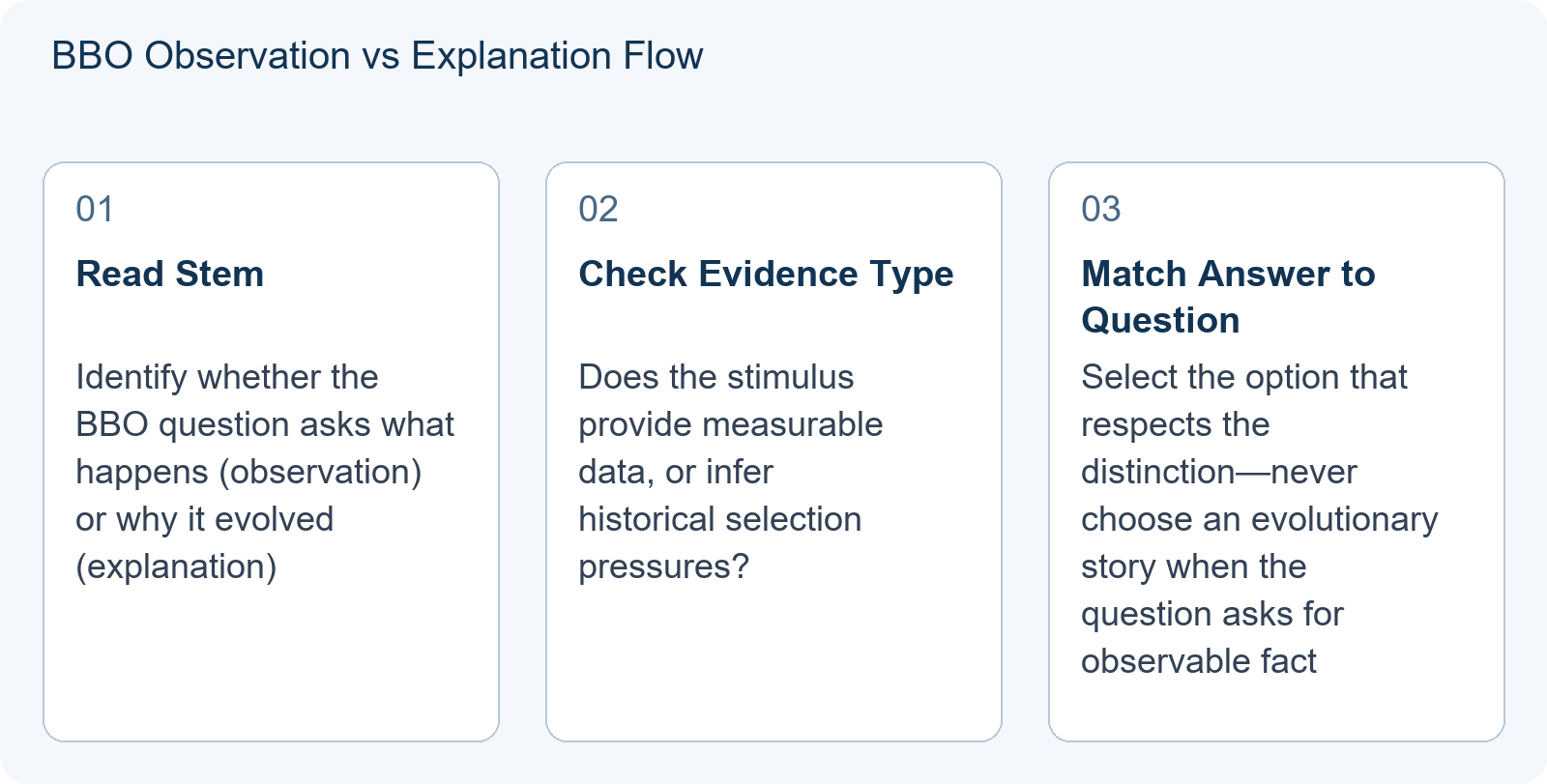
The critical skill is recognising which type of statement a question asks for. Multiple-choice items may test whether you can identify an observation versus an explanation, or evaluate whether a proposed explanation is supported by given evidence.
Worked Teaching Illustration: Stickleback Fish Aggression
Teaching illustration — not an actual contest problem.
Consider this scenario:
- A researcher observes that male three-spined sticklebacks attack any object with a red underside near their nest.
- The same researcher notes that attacks increase when the red area is larger.
- A textbook states: “Red bellies signal readiness to compete; aggression evolved to defend territories.”
Questions might ask:
- Which statements are observations? (Answer: 1 and 2)
- Which is an evolutionary explanation? (Answer: 3)
- Is the explanation fully supported by the observations alone? (Answer: No – the observations show correlation but do not prove evolutionary history or selective advantage.)
Students preparing for BBO animal behaviour questions should note that statement 3 requires inference about past selection pressures, not merely description of current behaviour.
Contrasting Case: When Explanation Masquerades as Observation
Teaching illustration — not an actual contest problem.
Consider a different scenario involving a hypothetical species, BirdA:
- Statement A: “Male BirdA build elaborate structures at display sites.”
- Statement B: “Structure building increases mating success through female choice.”
Here the observation (A) and explanation (B) are both plausible and both short. The trap for BBO candidates is different from the stickleback case: where the stickleback explanation was clearly marked as textbook content, the BirdA explanation (B) uses language that sounds like it follows directly from (A). It does not. Statement A records spatial behaviour; statement B makes a claim about sexual selection mechanism and fitness outcome that requires additional evidence (female visitation rates, paternity data, or experimental manipulation of structure presence).
The contrast between cases: in the stickleback example, the explanation was externally sourced and clearly separable; in the BirdA example, the explanation is syntactically close to the observation and easier to mistake for a direct inference. Both cases illustrate the same principle: observation does not become explanation by accumulation.
Diagnostic Application: Classifying Statements
Teaching illustration — not an actual contest problem.
Use this exercise to test your understanding. For each statement, label it as O (observation), E (evolutionary explanation), or X (external claim not directly about evolutionary mechanism):
| Statement | Classification | Reasoning |
|---|---|---|
| “Dogs wag their tails more when greeting familiar people than strangers.” | O | Directly measurable behaviour difference. |
| “Tail wagging evolved as a social bonding mechanism.” | E | Hypothesis about evolutionary origin. |
| “A domestic cat produces low-frequency vocalisations during rest.” | O | Measurable acoustic behaviour; note that any claim about therapeutic application in humans is an external (X) claim, not an evolutionary explanation of the behaviour itself. |
| “Male BirdA build elaborate structures at display sites.” | O | Recordable spatial behaviour. |
| “Structure building increases mating success through female choice.” | E | Sexual selection hypothesis requiring fitness data. |
If you misclassified any item, review whether you confused descriptive patterns with causal evolutionary claims, or whether a statement mixes observational and explanatory levels.
Proximate and Ultimate: Coexisting Explanations
A common error is treating proximate explanations (how a behaviour works, including learned components) and ultimate explanations (why it evolved, including kin selection) as mutually exclusive alternatives. They are not. For example, alarm calling in ground squirrels may involve both learned recognition of predators (proximate) and kin-selected benefit to relatives (ultimate). A BBO question might present both and ask which level of analysis a particular piece of evidence supports, or whether both can apply simultaneously. The correct response recognises that these explanations address different questions and can coexist.
What This Means for Your Next Learning Task
When studying animal behaviour for the BBO, focus on:
- Identifying key experiments that distinguish observation from interpretation (e.g., Tinbergen’s four questions: mechanism, ontogeny, function, and phylogeny).
- Practicing evaluation of whether given evidence supports a proposed evolutionary mechanism.
- Noting where plausible-sounding explanations lack direct observational backing.
Useful feedback should clarify whether errors stem from misreading question stems, confusing correlation with causation, or lacking knowledge of specific behavioural studies.
Related Preparation Resources
For further practice with mathematical tools relevant to behavioural data analysis, see BBO Hardy-Weinberg Questions: Checking Assumptions Before Using the Equation. To strengthen graph-interpretation skills relevant to behavioural data, consult BBO Logarithmic Graphs: Reading Biological Change Without Misreading the Axis. For broader misconception avoidance across biology topics, review BBO Misconceptions to Unlearn Before January (2026-27): 15 Confident Biology Errors, Area by Area.
Course-Fit and Resource Request Preparation
If you seek targeted support, prepare by noting:
- Specific BBO past-paper questions where you struggled with behaviour vs. evolution distinctions.
- Whether your difficulty lies in identifying observations, evaluating explanations, or both.
- Your current familiarity with classic ethology studies (e.g., Lorenz, Tinbergen, Wilson).
This helps instructors address precise gaps rather than generic content.
Applying the Distinction to Experimental Design
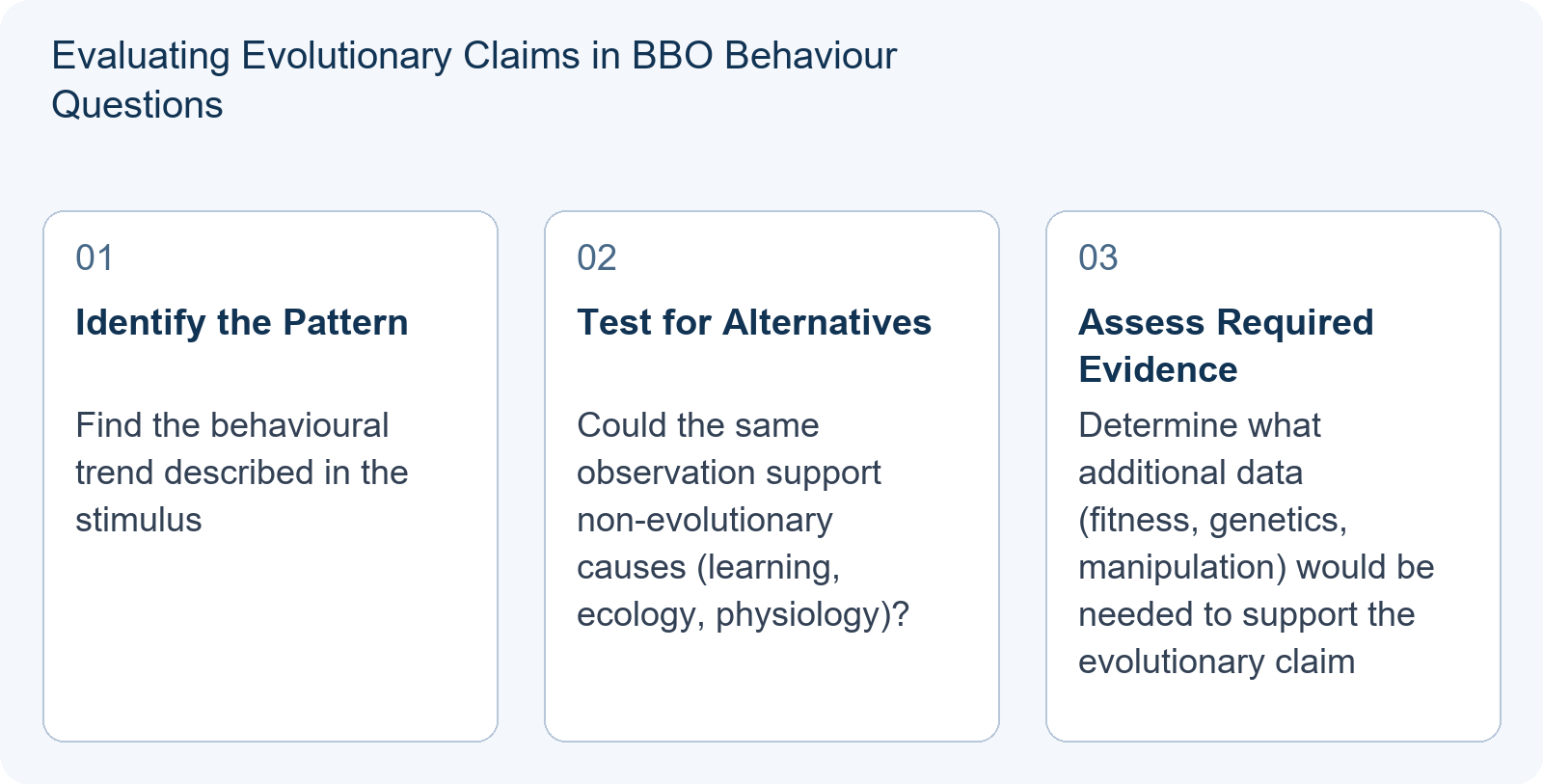
Once you can separate observations from evolutionary explanations, the next practical step is using that distinction to evaluate experimental design. BBO questions often present a scenario where a researcher claims to have tested an evolutionary hypothesis but actually only recorded descriptive data. Recognising this gap requires checking whether the experiment isolates the selective pressure or merely documents current behaviour.
Teaching illustration — not an actual contest problem.
Consider a hypothetical study on BirdA (from the previous section). A researcher wants to test the explanation: “Structure building increases mating success through female choice.” They set up two groups of males in identical enclosures:
- Group 1: Males are provided with natural materials to build structures.
- Group 2: Males are prevented from building by removing all materials.
The researcher records the number of females entering each enclosure over one hour. The results show Group 1 has twice as many visitors as Group 2. The researcher concludes: “This proves female choice drives the evolution of structure building.”
Is this conclusion valid? No. The observation (more visitors) supports the proximate mechanism (females prefer sites with structures), but it does not prove the ultimate evolutionary explanation (that this preference drove the trait’s evolution via differential reproductive success). To support the evolutionary claim, the study would need to track paternity outcomes or long-term fitness differences, not just immediate visitation rates. Furthermore, the control group lacked materials entirely, which might affect male display behaviour independently of structure presence, introducing a confounding variable.
This example highlights a common error: treating a short-term behavioural response as evidence for historical selection. When evaluating such questions, ask three diagnostic checks:
- Does the measurement link directly to fitness? Visitation rate is a proxy for mating opportunity, not confirmed reproductive success. Without paternity tests or offspring counts, the fitness link remains inferred, not observed.
- Are alternative explanations ruled out? Could females be responding to male movement patterns rather than the structure itself? If the experiment did not control for male activity levels, the causal link to structure building is weak.
- Is the timescale appropriate? Evolutionary explanations require evidence across generations or comparative phylogenetic data. A single-hour observation cannot demonstrate how a trait evolved; it can only show current function.
Students should practice rewriting conclusions to match the strength of the evidence. Instead of “This proves female choice drove evolution,” a more accurate statement based on the data would be: “Females visited enclosures with structures more frequently, suggesting structures may influence mate attraction in the current population.” This revised statement stays within the bounds of the observation and avoids unsupported evolutionary inference.
By applying these checks, you transform passive reading into active evaluation. In BBO multiple-choice items, options often include statements like “The experiment confirms the trait evolved due to sexual selection” versus “The experiment demonstrates a correlation between structure presence and female visitation.” The latter is the defensible answer because it reflects what was measured, not what was assumed. Mastering this skill ensures you do not lose marks for over-interpreting data, a frequent pitfall in animal behaviour questions.
Refining the Diagnostic: From Classification to Evidence Evaluation
The previous section introduced a diagnostic table for classifying statements as Observations (O), Evolutionary Explanations (E), or External Claims (X). While useful for initial recognition, BBO questions often require a deeper skill: evaluating whether a specific piece of evidence supports an evolutionary claim. This stage moves beyond labeling to assessing logical sufficiency.
Teaching illustration — not an actual contest problem.
Consider the BirdA scenario again. We have two statements:
- O1: “Male BirdA build elaborate structures at display sites.”
- E1: “Structure building increases mating success through female choice.”
A student might correctly label O1 as an observation and E1 as an explanation. However, a common error is assuming that because both are true in the narrative, O1 provides sufficient evidence for E1. It does not. To test your understanding, evaluate the following hypothetical data points against E1:
| Hypothetical Data Point | Does it support E1? | Reasoning |
|---|---|---|
| Females visit males with larger structures more frequently than those with smaller ones. | Partially | This supports the proximate mechanism (female preference) but does not prove this preference drove the trait’s evolution over generations. It shows current function, not historical selection. |
| Males with larger structures sire more offspring than males with smaller structures. | Yes | This links the behaviour directly to differential reproductive success (fitness), which is the core requirement for an evolutionary explanation via natural/sexual selection. |
| Building structures takes significant energy and time. | No | This describes cost, not benefit. Without evidence of offsetting fitness gains, high cost alone does not explain why the trait persists; it might even suggest it should be selected against unless benefits outweigh costs. |
Diagnostic Answer Key:
- Data Point 1: Supports proximate cause (current mate attraction) but is insufficient for ultimate explanation (evolutionary history) without longitudinal or comparative data showing heritable fitness advantages.
- Data Point 2: Strongly supports E1 because it demonstrates the selective pressure: higher fitness associated with the behaviour.
- Data Point 3: Does not support E1. Cost is relevant to trade-off models but does not independently validate the adaptive significance of the behaviour.
Next Practice Task:
Take any animal behaviour study you have read recently (e.g., from a textbook or past paper). Identify one evolutionary claim made about the behaviour. Then, list three pieces of evidence presented in the text. For each piece, ask: “Does this evidence demonstrate differential reproductive success linked to the behaviour?” If the answer is no, classify it as supporting only the proximate mechanism or descriptive pattern. This habit prevents the over-interpretation trap where correlation is mistaken for causal evolutionary proof.
Frequently Asked Questions
Can an observation ever be an evolutionary explanation?
No. Observations describe what happens; evolutionary explanations propose why it happened through natural or sexual selection. They are logically distinct categories.
How do I know if a BBO question wants observation or explanation?
Look for verbs: ‘record’, ‘measure’, ‘note’ suggest observation; ‘explain’, ‘propose’, ‘suggest why’ indicate explanation. Context clues matter more than single words.
Are all evolutionary explanations equally valid?
No. Validity depends on supporting evidence. Some hypotheses are well-tested (e.g., kin selection in eusocial insects); others remain speculative without fitness data.