
For many students preparing for the British Biology Olympiad (BBO), Hardy-Weinberg equilibrium questions present a specific trap. The difficulty is rarely in the algebra of p² + 2pq + q² = 1. Instead, it lies in recognizing when the equation is valid to use. A frequent error involves applying the formula blindly to scenarios where evolutionary forces are active, leading to incorrect conclusions about allele frequencies.
This guide addresses that narrow reasoning failure. We will not repeat broad registration advice found in our BBO Registration 2027: What to Do When Your School Will Not or Cannot Enter You. Instead, we focus on the logical checks required before calculation, using original teaching illustrations rather than official past-paper questions.
The Core Difficulty: Assumption Verification
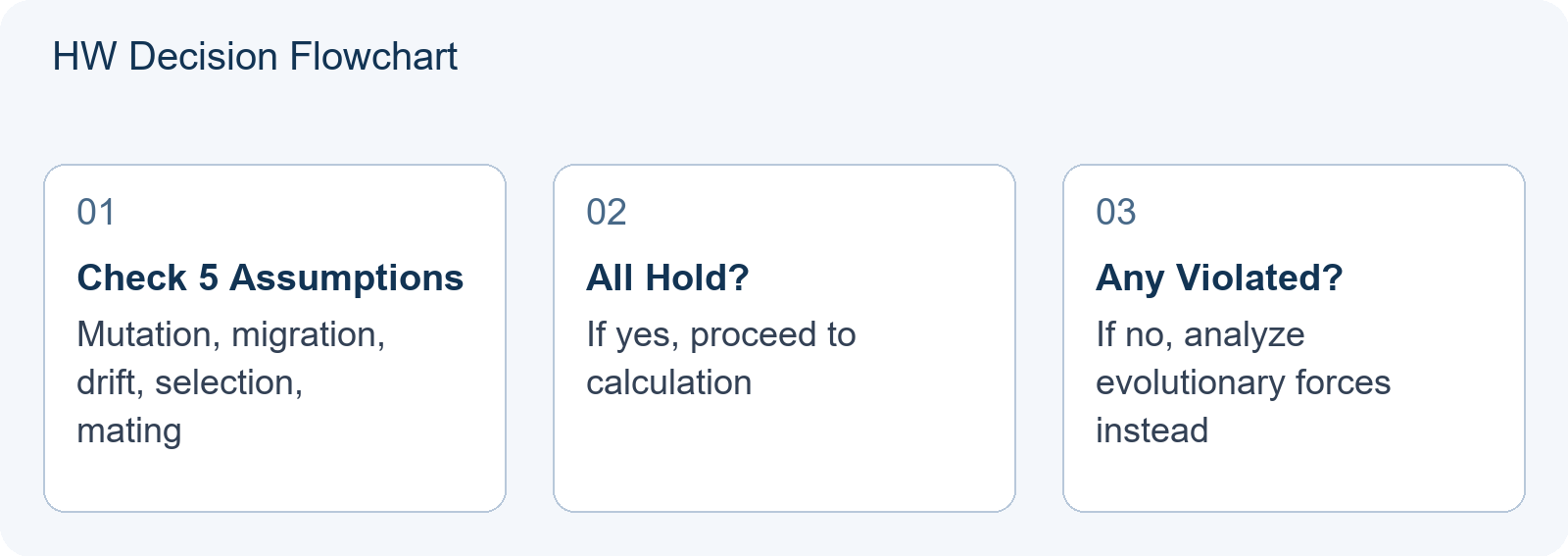
Hardy-Weinberg equilibrium describes a theoretical state where allele frequencies remain constant from generation to generation. This stability only occurs if five strict conditions are met:
- No mutation
- No gene flow (migration)
- Random mating
- Infinite population size (no genetic drift)
- No natural selection
BBO questions often embed subtle violations of these conditions in the scenario description. If you calculate expected genotype frequencies without checking these assumptions, your answer may be mathematically correct but biologically invalid.
Worked Example 1: Valid Application
Hypothetical Scenario: In a large, isolated population of beetles, wing color is determined by two alleles: dominant W (white wings) and recessive w (black wings). Mating is random, and no environmental pressures affect survival. Genetic testing reveals that 4% of the population has black wings.
Step-by-Step Reasoning:
- Check Assumptions: “Large, isolated” suggests no drift or gene flow. “Random mating” is explicit. “No environmental pressures” implies no selection. No mention of mutation. The conditions for Hardy-Weinberg appear satisfied.
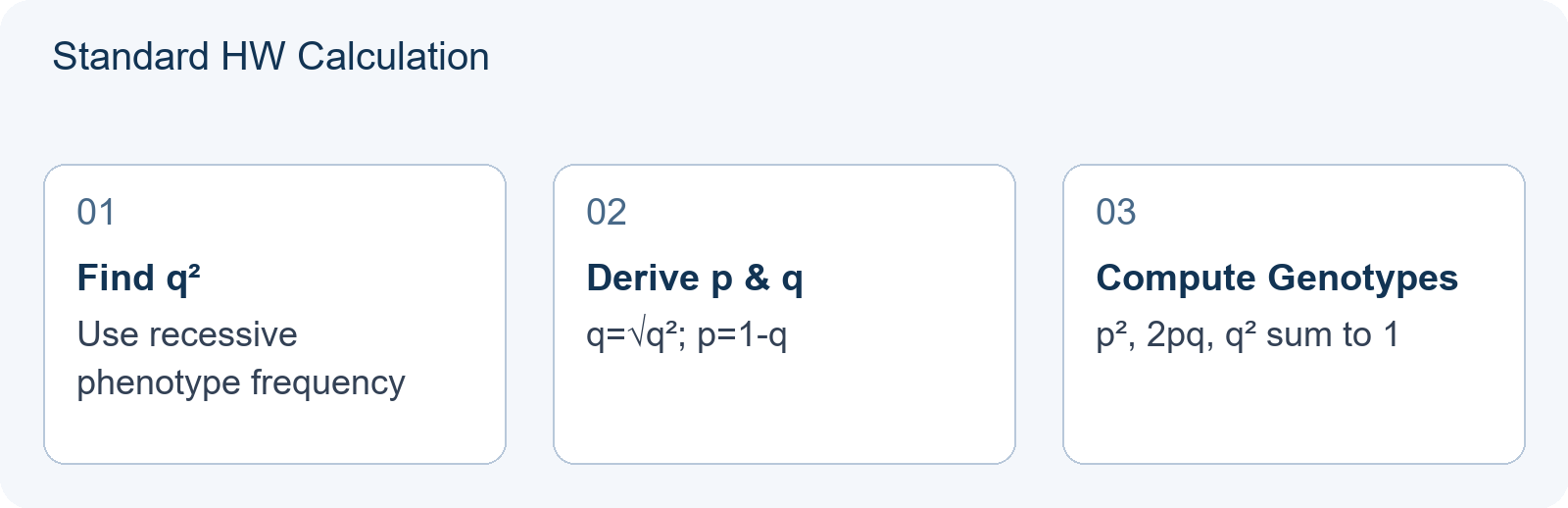
- Identify Knowns: Black wings are recessive (ww). Frequency of homozygous recessive genotype (q²) = 0.04.
- Calculate Allele Frequencies: q = √0.04 = 0.2. Since p + q = 1, p = 1 – 0.2 = 0.8.
- Calculate Expected Genotypes: Homozygous dominant (WW) = p² = 0.64. Heterozygous (Ww) = 2pq = 2(0.8)(0.2) = 0.32.
- Verify Sum: 0.64 + 0.32 + 0.04 = 1.00. The calculation holds.
In this case, direct application of the equation is appropriate because the scenario explicitly supports equilibrium conditions.
Worked Example 2: Invalid Application
Hypothetical Scenario: A small island population of lizards exhibits tail length variation controlled by two alleles. Researchers observe that individuals with long tails have higher survival rates due to predator evasion. After one generation, the frequency of the long-tail allele increases significantly.
Common Mistake: Students might attempt to calculate expected genotype frequencies using current allele counts and Hardy-Weinberg formulas, assuming the population is stable.
Correct Reasoning:
- Check Assumptions: “Small island population” violates infinite size (genetic drift likely). “Higher survival rates” explicitly indicates natural selection.
- Determine Applicability: Because selection and drift are active, the population is NOT in Hardy-Weinberg equilibrium. Allele frequencies are changing.
- Conclusion: Do not use p² + 2pq + q² = 1 to predict next-generation genotypes. Instead, analyze the direction of change based on selective advantage. The question likely asks for interpretation of evolutionary trends, not static calculations.
Applying the equation here would yield misleading predictions because the underlying model assumes stability, which contradicts the observed selection pressure.
Diagnostic Table: When to Use Hardy-Weinberg
| Scenario Feature | Implication for HW Equilibrium | Action Required |
|---|---|---|
| Explicit “random mating” stated | Supports equilibrium assumption | Proceed with calculation if other conditions hold |
| Mention of “small population” or “island” | Suggests genetic drift violation | Question validity; focus on stochastic changes |
| Described survival/reproductive advantage | Indicates natural selection violation | Do not assume constant frequencies; analyze trend |
| Migration or gene flow mentioned | Violates isolation assumption | Recalculate allele pools considering influx/outflux |
| Only phenotype frequency given | Insufficient data alone | Check if equilibrium is assumed; derive q from recessive phenotype |
Targeted Practice Sequence
To build this skill, follow this sequence during preparation:
- Identify Conditions: For each practice question, list which of the five HW assumptions are explicitly supported or violated by the text.
- Decide Method: If all assumptions hold, apply the equation. If any are violated, shift to qualitative analysis of evolutionary forces.
- Review Errors: Compare your decision against answer explanations. Note whether mistakes stemmed from calculation errors or misjudging applicability.
Our BBO Tutoring: Choose the Right Biology Support for Your 2027 Preparation offers further support options. Additionally, our BBO Past Papers: How to Use Them When Answers Are Not Enough explains how to interpret answer keys effectively.
Next Skill Demonstration
A learner should be able to demonstrate the following after mastering this concept:
- Articulate why Hardy-Weinberg is a null hypothesis rather than a universal law.
- Quickly scan BBO-style prompts for keywords indicating selection, drift, or non-random mating.
- Choose between quantitative calculation and qualitative evolutionary analysis based on context clues.
This distinction is critical for high-level biology competitions where conceptual accuracy outweighs mechanical computation.
Frequently Asked Questions
Can I always use Hardy-Weinberg for BBO genetics questions?
No. Only use it when the scenario explicitly states or strongly implies that the five equilibrium conditions (no mutation, no gene flow, random mating, large population, no selection) are met.
What if the question mentions natural selection?
If natural selection is mentioned, the population is not in equilibrium. You cannot use p²+2pq+q²=1 to predict stable frequencies. Focus on describing the direction of allele frequency change instead.
How do I identify the recessive allele frequency?
In a valid Hardy-Weinberg scenario, the frequency of the homozygous recessive genotype (q²) equals the proportion of individuals showing the recessive phenotype. Take the square root of q² to find q.