
Many students preparing for the British Biology Olympiad (BBO) struggle with questions that require connecting detailed molecular mechanisms to broader physiological or ecological outcomes. For the 2027 sitting, this skill matters more than ever: the China-region paper on January 16, 2027 is a single 90-minute test, while the UK format runs across two papers. In both cases, you need to move fast from molecule to organism. This article offers a structured approach to BBO Biology Revision that builds integrated understanding rather than isolated memorization.
The Core Challenge: From Molecule to Organism
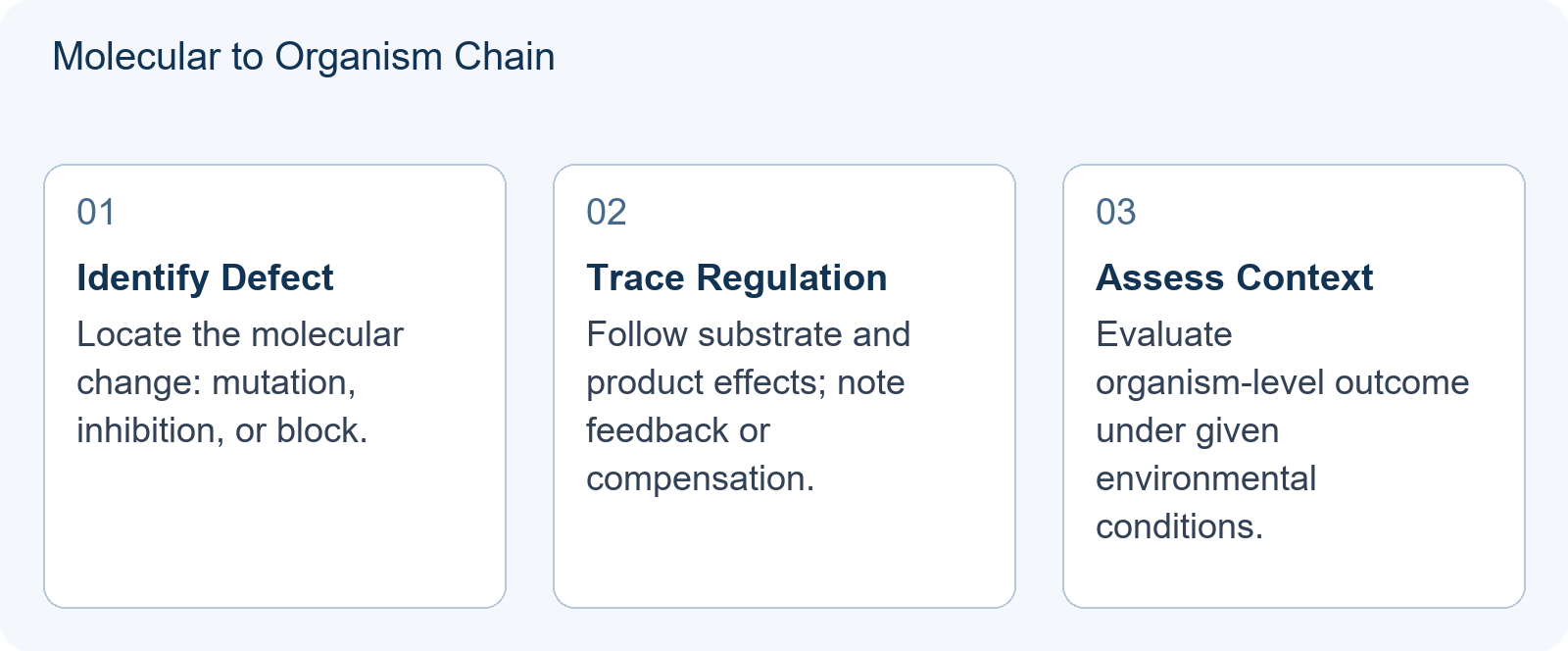
The BBO syllabus spans cell biology, plant and animal anatomy and physiology, animal behavior, genetics and evolution, ecology, and biological classification. Questions frequently test your ability to traverse these levels. A question might describe a genetic mutation affecting an enzyme in a biosynthetic pathway and ask about its impact on an organism’s phenotype, behavior, or fitness in a specific environment. To answer correctly, you need to understand the molecular defect, trace its biochemical consequence, identify the physiological or developmental outcome, and finally evaluate the ecological or evolutionary implication.
For the 2027 China-region candidates sitting the single paper on January 16, the compression into 90 minutes means you cannot afford to reconstruct this chain slowly. The UK format uses two papers. BBO Biology Revision must therefore practice speed and accuracy in causal chaining.
Teaching Illustration: Plant Pigment Pathway and Feedback Compensation
Teaching Illustration: This is a constructed scenario to demonstrate the reasoning process, not an official BBO question.
Imagine a hypothetical plant species that produces a red pigment through a two-step pathway: Compound A is converted to Compound B by Enzyme 1, and Compound B is converted to the red pigment by Enzyme 2. The red pigment is the sole visible pigment in flowers. A researcher identifies a mutant with a non-functional Enzyme 2.
Step 1 — Molecular defect: The mutation eliminates Enzyme 2 activity. Compound B accumulates because it cannot be converted to pigment, assuming continued upstream flux.
Step 2 — Biochemical consequence: The build-up of Compound B may inhibit Enzyme 1 through feedback inhibition, reducing flux through the entire pathway. Alternatively, if Compound B is toxic at high concentration, cellular damage may occur. If no diversion pathway exists, white flowers result from the absence of red pigment.
Step 3 — Physiological consequence: Without the red pigment, the plant’s flowers are white. This may affect pollinator attraction if the pollinator uses color as a cue.
Step 4 — Organism-level and ecological effect: If pollinator preference for red is strong and pollen limitation occurs, seed set may be reduced. However, the feedback inhibition on Enzyme 1 may reduce Compound B toxicity, allowing survival. Alternatively, if a second metabolic route diverts Compound B to a green pigment, compensation occurs and the phenotype changes. These are alternative hypothetical models. In the initial model, upstream flux continues and no diversion occurs; white means an absence of visible pigment, not accumulation of a white pigment.
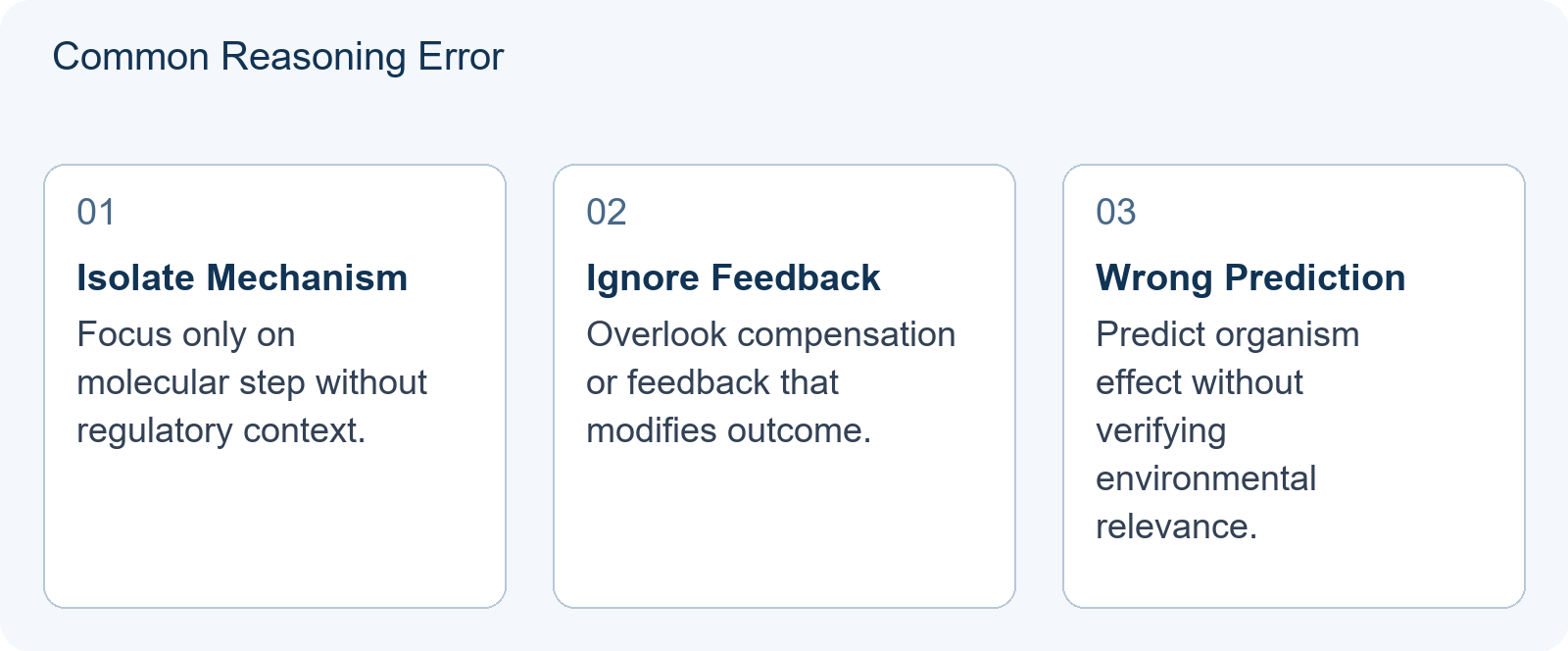
The critical point: feedback and compensation modify the outcome. A student who stops at “no pigment means white flowers” misses the metabolic regulation. A student who notes feedback inhibition but ignores pollinator ecology also misses the mark. BBO Biology Revision must practice tracing the full chain and noting where regulation intervenes.
Contrasting Case: Where Superficial Similarity Misleads
Teaching Illustration: Constructed to show when similar molecular logic fails.
Consider a second hypothetical plant with the same pathway, but where Compound B is not toxic and does not feedback-inhibit Enzyme 1. Instead, the plant has a separate regulatory system: pigment production is induced only under high light. In low light, the pathway is transcriptionally repressed regardless of enzyme function.
A student applies the first case’s reasoning—”mutant in Enzyme 2 means white flowers”—and predicts reduced fitness. But in low light, the wild-type would also be white because the pathway is repressed. The mutation is phenotypically silent in that environment. The error is assuming the molecular defect automatically produces an organism-level effect. Context—here, environmental regulation—determines whether the molecular change matters.
This contrast teaches a key BBO Biology Revision principle: always check whether the condition where the molecular change operates is actually the condition the organism experiences.
Teaching Illustration: Hemoglobin, Oxygen Affinity, and Context-Dependent Tradeoffs
Teaching Illustration: Constructed to show the loading-unloading tradeoff, not universal high-altitude adaptation.
Hemoglobin’s oxygen affinity presents a well-known tradeoff. Higher affinity improves oxygen loading under hypoxic conditions, such as at high altitude where partial pressure of oxygen is low. However, higher affinity also reduces oxygen unloading at tissues, where oxygen must be released to respiring cells.
Whether higher affinity improves net oxygen delivery depends on which step is limiting under the specific conditions. In an environment with very low atmospheric oxygen, loading may be so impaired that increasing affinity raises total delivery despite reduced unloading. In an environment with moderate oxygen but high metabolic demand, unloading may be the bottleneck, and higher affinity would reduce delivery. There is no universal “high-altitude” optimum—only a context-dependent balance between loading and unloading.
Students often err by treating higher affinity as automatically beneficial for hypoxic environments. The correct reasoning requires comparing loading and unloading under the given oxygen levels, not invoking a general rule.
Diagnostic Application: Tracing a Metabolic Defect With Feedback
Try this diagnostic exercise based on the plant pigment pathway:
A mutant lacks functional Enzyme 1 (A → B). Predict the consequences and identify where feedback or compensation could modify the outcome.
- Molecular Level: No conversion of A to B; substrate A accumulates, assuming continued input without alternative use.
- Cellular Level: If A is toxic, accumulation may damage cells. If A can enter an alternative pathway producing a brown pigment, compensation occurs.
- Whole-Organism Effect: Without B, no red pigment forms. Flowers are white. If A is toxic and not diverted, growth may be stunted.
- Feedback/Compensation Check: Does high A repress its own uptake? Does the plant upregulate the alternative pathway? These modify the final phenotype.
Check your reasoning: Did you trace both the loss of product (no B, no red pigment) and the potential consequences of substrate accumulation (toxicity or diversion)? Did you explicitly identify where feedback or compensation could alter the outcome? If you stopped at “white flowers,” your chain was incomplete.
Interpreting Your Diagnostic Result
If you struggled with the diagnostic, your BBO Biology Revision needs targeted adjustment. You likely have factual knowledge but insufficient practice in causal chaining with regulatory context.
The next learning task: take any pathway, disease, or adaptation from the syllabus and write the explicit chain: Gene → Protein Function → Metabolic Consequence → Cellular/Tissue Effect → Organism Phenotype → Environmental Interaction. Then add: What feedback or compensation could modify this outcome?
Useful feedback identifies exactly where your chain breaks. Is it at the metabolic-to-cellular transition? Do you miss environmental context? Do you forget regulatory feedback? Targeting these specific gaps outperforms indiscriminate re-reading.
BBO-Specific Format Context for 2027
For China-region candidates, the January 16, 2027 paper is a single 90-minute session with multiple-choice, fill-in, and ordering questions. Registration closes January 5, 2027. The UK format uses two papers. Plan practice around the published syllabus for your region. Your BBO Biology Revision should include timed practice that forces rapid causal chaining.
Strategic Revision Tips for Integrated Questions
When revising genetics, evolution, or physiology, always ask: “Under what conditions does this molecular detail matter for the organism?” Create study materials that pair mechanisms with organism-level consequences, and explicitly note feedback or compensation points. Practice explaining chains aloud to expose hidden assumptions.
Related Resources and Next Steps
For further guidance on specific aspects of preparation, review our articles on BBO Hardy-Weinberg Questions: Checking Assumptions Before Using the Equation, which also require careful contextual application; BBO Past Papers: How to Use Them When Answers Are Not Enough for structured practice; and BBO Misconceptions to Unlearn Before January (2026-27): 15 Confident Biology Errors, Area by Area to avoid typical traps in multi-level questions.
Evidence Versus Inference: A Diagnostic Table for the Pigment Pathway
Teaching Illustration: This section builds on the plant pigment scenario to show how observations distinguish competing causal explanations. It is constructed for practice, not drawn from official BBO materials.
When you face a BBO question that describes a mutant phenotype, you must decide whether your predicted outcome is a direct consequence of the molecular defect or an inference that requires additional assumptions. The pigment pathway offers a clear framework for this discipline. Below is an evidence-versus-inference table that lists what you could directly observe, what you must infer, and what additional observation would test each inference.
| Claim | Evidence or Inference? | What Would Test It? |
|---|---|---|
| Enzyme 2 is non-functional | Evidence (given in stem) | Assay catalytic activity; a sequence change alone does not establish loss of function |
| Compound B accumulates | Prediction under continued input and no alternative loss | Chromatography or mass spec of extract |
| Red pigment is absent | Prediction under the stated pathway assumptions | Spectrophotometry of flower extract |
| Flowers are white | Inference (depends on absence of other pigments) | Check for alternative pigment pathways; inspect under light that reveals UV patterns |
| Feedback inhibition of Enzyme 1 occurs | Inference (conditional on regulatory mechanism) | Measure Enzyme 1 activity at varying B concentrations; check allosteric binding site |
| Pollinator visits decrease | Inference (depends on pollinator behavior and alternatives) | Field observation with controlled flower arrays; test pollinator preference directly |
| Seed set is reduced | Inference (depends on pollination success and pollen limitation) | Count seeds per fruit; hand-pollinate controls |
| Compound B is toxic | Inference (not automatic) | Growth assays; cell viability staining |
The critical skill is recognizing which predictions are robust and which are contingent. The accumulation of Compound B and the absence of red pigment are direct consequences of the enzyme block, assuming continued upstream flux and no diversion. Whether this produces white flowers, however, depends on whether other pigments are present—a point the initial model assumes for simplicity but which you must verify. Similarly, feedback inhibition is a plausible regulatory response but not an automatic one; the proposed inhibitory mechanism must be demonstrated under the relevant conditions.
Distinguishing Causal Explanations with Observations
Suppose two students propose different explanations for why a particular Enzyme 2 mutant survives despite Compound B accumulation:
Explanation X: Feedback inhibition reduces flux, keeping B below toxic levels.
Explanation Y: A diversion pathway converts B to a harmless storage compound.
These explanations make different predictions. If Explanation X is correct, you would expect to find reduced flux through the entire pathway and lower total metabolite throughput. If Explanation Y is correct, you would expect normal or near-normal upstream flux but altered downstream products. These measurements help distinguish the simplified explanations, but both mechanisms could operate together; one observation alone need not exclude the other. This is the level of reasoning BBO integration questions target: not merely tracing a pathway, but designing discriminating observations.
Explicit Diagnostic Answer
When answering a BBO question about this pathway, structure your response as follows:
- State the direct consequence: Identify what must happen given the enzyme block and the model assumptions (accumulation of substrate, loss of product).
- Flag conditionals: Note where regulatory mechanisms, alternative pathways, or environmental context could modify the outcome.
- Distinguish evidence from inference: Separate what the question states or what you can directly deduce from what requires additional assumptions.
- Propose a test: If the question asks you to evaluate competing explanations, identify the observation that would discriminate between them.
Concrete Practice Action
Take the pigment pathway and write three variant scenarios: one where feedback inhibition operates, one where a diversion pathway exists, and one where both are absent. For each, predict the flower color, the metabolic profile, and the ecological consequence. Then identify one observation that would allow you to distinguish each scenario from the others. Repeat this with any pathway from the BBO syllabus—photosynthesis, respiration, nitrogen metabolism—until the pattern becomes automatic. The goal is not to memorize outcomes but to internalize the discipline of tracing consequences while explicitly tracking your assumptions.
Frequently Asked Questions
Do I need to memorize every metabolic pathway for the BBO?
No. Focus on understanding how pathways are regulated and how defects cascade to organism-level effects. The BBO tests integration, not encyclopedic memorization. Know the major pathways in the syllabus and practice causal chaining.
How should I adapt my revision for the China single-paper format versus the UK two-paper format?
Confirm your regional format and practise complete timed sessions of that duration. Use short causal-chain exercises between full papers; the number of papers alone does not establish time available per question or comparative difficulty.
Where does the BBO syllabus come from if not the Royal Society of Biology?
The British Biology Olympiad is organized by the UK Biology Competitions (UKBC) with ASDAN operating the China region. The syllabus covers cell biology, plant and animal anatomy and physiology, animal behavior, genetics and evolution, ecology, and biological classification. Always verify current format details through official ASDAN or UKBC channels.