
Why Answer Keys Alone Create a False Sense of Progress
Many students download BBO past papers, check their answers, and move on—only to see no improvement on the next attempt. This is the completion trap: the brain registers “finished” rather than “learned.” With approximately 90 questions in 90 minutes, the BBO demands both speed and precision. Simply knowing what you got wrong is not the same as understanding why the error happened or how to prevent it.
The BBO includes multiple-choice, fill-in, and ordering formats, with chart-analysis questions accounting for approximately 30% of the exam. Answer keys show the correct choice but rarely explain the data-reading strategy behind it. Without a systematic review method, students repeat the same blind spots across papers.
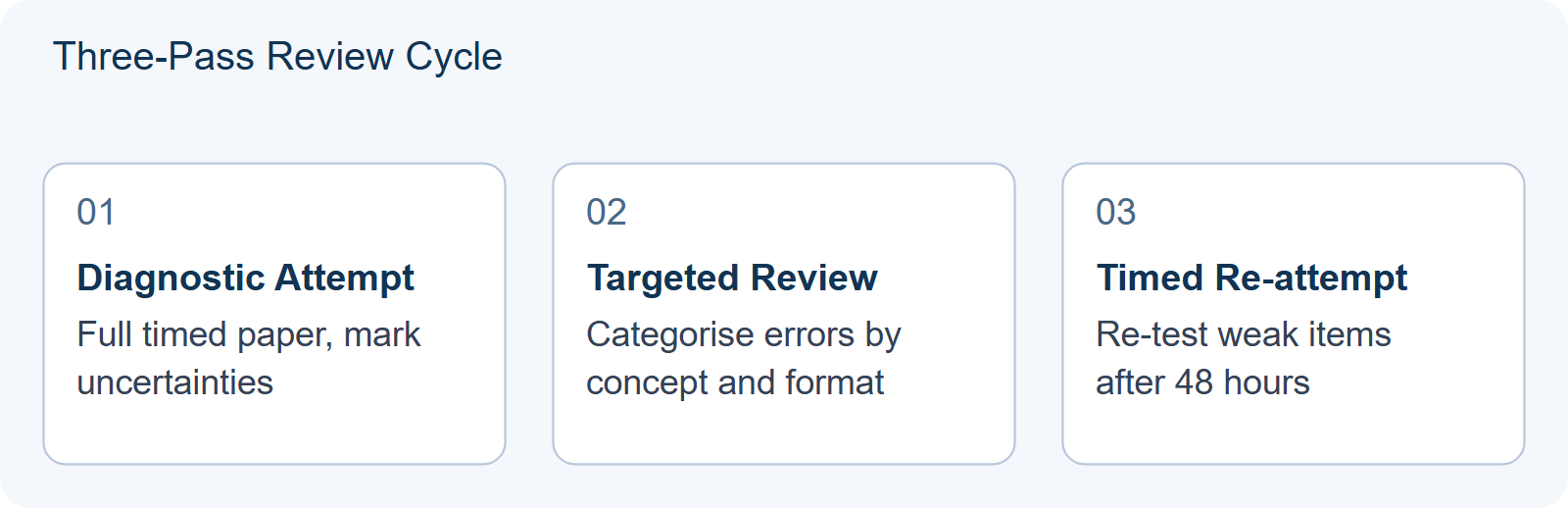
The Three-Pass Paper Method
We suggest treating each past paper as a three-phase learning tool rather than a single test event. This is an educational framework we recommend based on common study-practice principles, not a Hanlin-official protocol.
First Pass: Diagnostic Attempt
Complete the paper under standard conditions—90 minutes, no interruptions. Do not check answers immediately. Instead, mark questions where you felt uncertain, even if you guessed correctly. This builds an honest map of confidence versus actual knowledge.
Second Pass: Targeted Review
Check answers only after a short break. For each error and marked uncertainty, write a one-sentence explanation of the biology concept involved, the question format that tripped you, and whether the issue was knowledge gap, misreading, or time pressure. This transforms passive checking into active diagnosis.
Third Pass: Timed Re-attempt
After at least 48 hours, re-attempt only the questions you missed or marked as uncertain. This tests whether your review created durable learning or just short-term familiarity. If you repeat the same error, the concept needs deeper study—not more papers.
Building a Personal Error Taxonomy
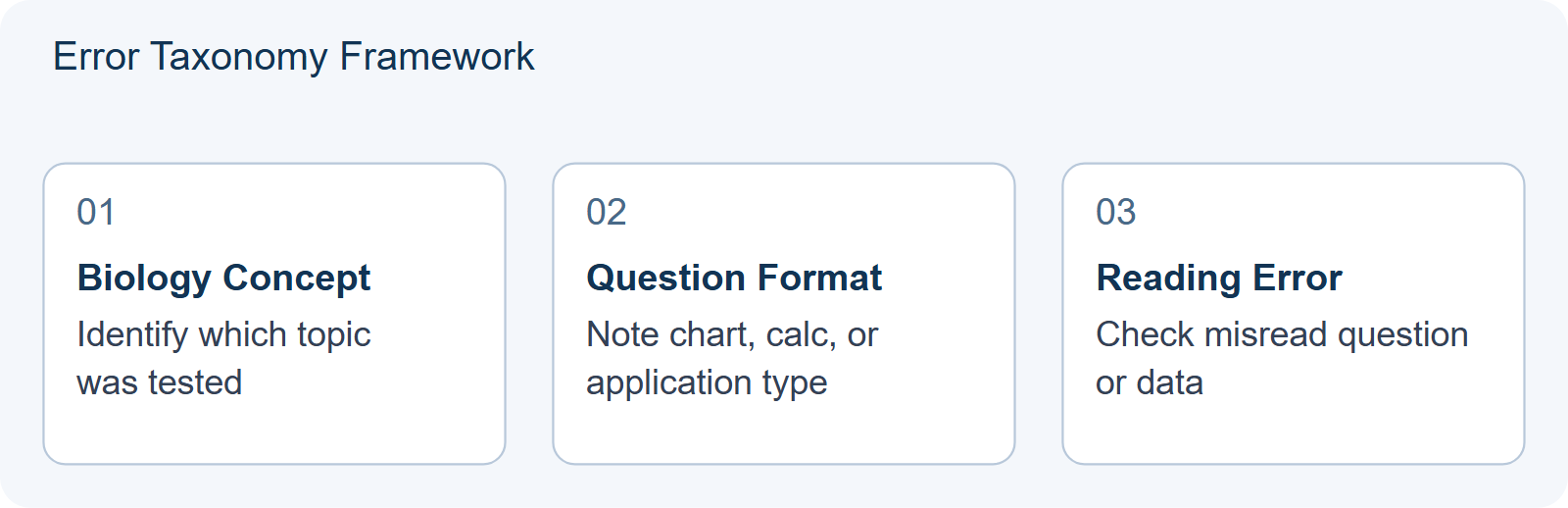
We recommend categorising every mistake into three columns:
- Biology concept: Which topic (e.g., cell biology, genetics, ecology) was tested?
- Question format: Was it a chart, a calculation, a definition, or an application scenario?
- Reading error: Did you misread the question, the data, or the options?
Over three to four papers, patterns emerge. A student might discover that 60% of their errors cluster in chart-based questions about ecology, or that they consistently misread “which is NOT correct” prompts. This specificity directs remaining study time far more efficiently than broad topic review.
Chart and Data Questions: The 30% That Answer Keys Rarely Explain
Chart-analysis questions represent a substantial portion of BBO marks. The answer key states which option is correct but typically does not walk through how to extract the answer from the data presented. We suggest practising these questions with a deliberate protocol:
- Identify what each axis represents before reading any question text.
- Note units, scales, and any breaks in the data.
- Formulate your own conclusion from the chart before looking at options.
- Only then match your conclusion to the closest option.
This reverses the common habit of reading options first and hunting for confirmation—a strategy that fails when distractors are well-designed.
When to Move On From a Paper
We suggest setting personal benchmarks before advancing to the next paper. These are advisory thresholds, not official requirements:
| Indicator | Suggested Benchmark |
|---|---|
| Accuracy on re-attempt | Comfortably above first-attempt score |
| Concept clarity | Can explain correct reasoning aloud without notes |
| Chart questions | Can identify what the chart shows before seeing options |
If these are not met, the paper still has teaching value. Rushing through ten papers with shallow review typically produces less improvement than deep work on four or five.
Supplementing Exhausted Papers
Once past papers are fully mined, students need fresh material that maintains BBO-style questioning. Hanlin offers selected notes and questions for USABO/BBO, which compile over 200 theme-classified questions. The notes are designed to support preparation for both competitions given the substantial knowledge overlap between the two.
Hanlin also provides 2026 BBO past papers and answers as free preparation materials. These are specific-year resources; we recommend confirming current availability with Hanlin directly.
Preparing for a Course-Fit Discussion
If you are considering structured support, we suggest preparing the following before speaking with any provider:
- Your most recent diagnostic paper score and timing.
- A list of your top three recurring error categories.
- Your target exam date and current weekly study hours.
This information allows any advisor to suggest appropriate next steps rather than generic recommendations. For Hanlin’s specific course options and scheduling, contact their team directly.
Related Preparation Paths
For students also considering USABO, the two competitions share significant content overlap. The BBO’s January timing and USABO’s April timing create a natural sequence for those wishing to attempt both. Our guide to dual-exam biology preparation outlines how to structure this without duplicating effort.
For a broader view of biology competition strategy, this article on building a biology olympiad study plan covers timeline and resource decisions.
And for families weighing whether to start with BBO or USABO, our comparison of the two competitions explains the format and difficulty differences in detail.
Key Facts About BBO Structure
From Hanlin’s published guidance (July 24, 2026):
- Exam duration: 90 minutes
- Question count: approximately 90
- Formats: multiple-choice, fill-in, ordering
- Chart-analysis component: approximately 30% of questions
Hanlin provides preparation support but is not affiliated with the British Royal Society of Biology or the USABO organisers. Competition results are not linked to any school admission or grading system in China.
Frequently Asked Questions
How many BBO past papers should a student complete before the exam?
Quality of review matters more than quantity. We suggest completing enough papers to identify stable error patterns—typically four to six with thorough three-pass review—rather than rushing through many with shallow checking.
Can BBO past papers alone prepare a student for the chart-analysis questions?
Past papers provide the raw material, but students need a deliberate protocol for reading charts before seeing options. We recommend extracting the chart's meaning independently before matching to answer choices.
What is the relationship between BBO and USABO preparation?
The two competitions share substantial content overlap. Their staggered timing—BBO in January and USABO in April—allows sequential preparation. Hanlin offers materials designed to support both exams.