
When families begin exploring BBO tutoring, they often face a crowded landscape of options with little guidance on how to match a program’s structure to a student’s actual needs. The British Biology Olympiad (BBO) demands more than strong school biology grades; it requires unfamiliar reasoning patterns, extensive vocabulary, and the ability to work accurately under time pressure. Choosing the wrong support format wastes money and months of preparation time. This article offers a practical framework for evaluating tutoring options, understanding what meaningful feedback looks like, and preparing for a course-fit conversation that actually reveals whether a provider can address your specific situation.
Understanding Your Starting Position: Curriculum Background Matters
Students arrive at BBO preparation from different academic systems, and these backgrounds create predictable patterns of preparation needs. According to observations from Teacher Yu at Hanlin Courses (September 21, 2026), school curricula transfer differently to competition demands:
- IGCSE students often bring broad but shallow foundational knowledge, with gaps in the depth of mechanistic understanding that BBO questions require
- AP Biology students frequently need strengthening in plant and animal diversity and physiology breadth, areas where the AP curriculum may be narrower than the BBO scope
- A-Level and IB students may need competition-specific depth and quantitative genetics, having solid school foundations but limited exposure to the integrated, multi-step reasoning that distinguishes BBO problems
Teacher Yu holds a bachelor’s degree in nutrition from the University of Wisconsin-Madison and a master’s in bioinformatics/computational biology from UT Dallas, and serves as editor of Hanlin’s USABO/BBO handouts. These observations represent diagnostic hypotheses based on coaching experience, not official exhaustive curriculum audits or guarantees that every student from these backgrounds will exhibit these patterns.
Your first step in selecting BBO tutoring should be honest assessment of where your school preparation leaves you relative to competition demands. The BBO preparation roadmap provides a broader overview of the preparation journey, while the syllabus analysis details the content scope you need to cover.
Matching Support Format to Diagnostic Need
Not every student benefits from the same tutoring structure. Consider this decision framework when evaluating options:
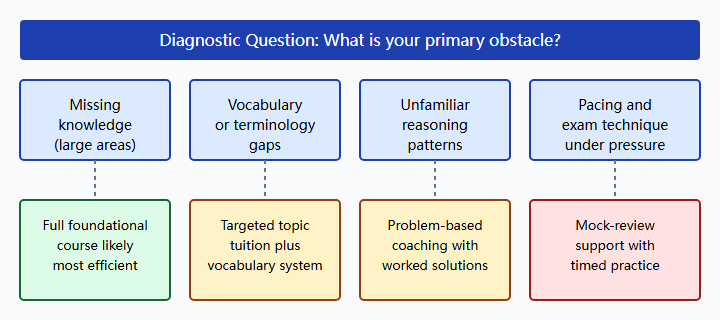
This matrix illustrates how different obstacles suggest different support formats. A student with large knowledge gaps across multiple modules needs fundamentally different intervention than one who understands content but cannot complete papers under time pressure. Some students may need elements of multiple formats; the key is identifying your primary bottleneck.
The four formats above—full foundational course, targeted topic tuition, mock-review support, and self-study—represent a spectrum of support intensity. Not all formats are necessarily offered by any given provider, including Hanlin. Your task is to match your diagnostic need to what a provider actually delivers, not to assume comprehensive options exist everywhere.
What Meaningful Feedback Looks Like
Generic score reports and “good effort” comments do not advance preparation. When evaluating BBO tutoring, ask specifically what feedback a student receives and how progress is tracked over time.
Consider a concrete example. A student writes in response to a practice question: “The correlation between increased enzyme activity and higher temperature shows that heat provides energy for the reaction.” This hypothetical practice response jumps from an association to a causal explanation. An answer needs the experimental conditions and a relevant mechanism; at sufficiently high temperatures, enzyme denaturation can instead reduce activity. Treat this as a reasoning exercise, not an official BBO question or mark scheme. Meaningful feedback would identify this error pattern specifically, explain why the distinction matters for interpreting evidence, and direct the student to relevant past problems requiring mechanistic explanations.
When interviewing providers, ask to see examples of what they mark and how they communicate corrections. Red flags include: feedback limited to correct/incorrect without explanation; no tracking of error patterns over time; no connection made between practice performance and subsequent lesson focus.
Hanlin’s online mock platform provides timed attempt, immediate score, and weakness report. This represents one approach to diagnostic feedback, the cited note does not specify whether additional human review is included, so confirm that separately.
Preparing for a Productive Course-Fit Conversation
Before engaging any BBO tutoring provider, prepare a brief that enables genuine assessment of fit. This preparation protects your time and ensures the consultation addresses substance rather than sales pressure.
Information to prepare:
- Current curriculum and year: IGCSE, A-Level, IB, AP, or other; specific awarding body where relevant
- School topic coverage to date: which modules completed, which in progress, which not yet started
- Recent practice attempts: past papers or problem sets attempted, with timing conditions and scores where available
- Specific errors and confusions: not just “got it wrong” but what you thought at the time and why
- Weekly time available: realistic hours for preparation, considering school commitments
- Desired learning scope: whether seeking comprehensive preparation or support in specific areas
Questions to ask the provider:
- What does tuition include—live sessions, materials, practice platforms, or other components?
- Is instruction individual, small group, or large group format?
- What is the scope of feedback—automated scoring, written comments, live discussion of errors?
- What is the schedule structure and what are the terms for changes or discontinuation?
Notice these questions focus on operational specifics, not outcomes. No provider can guarantee scores, awards, or admission outcomes. Any promise of guaranteed results should prompt immediate skepticism.
Evaluating Providers: Suggested Criteria
When comparing BBO tutoring options, consider these evaluation dimensions:
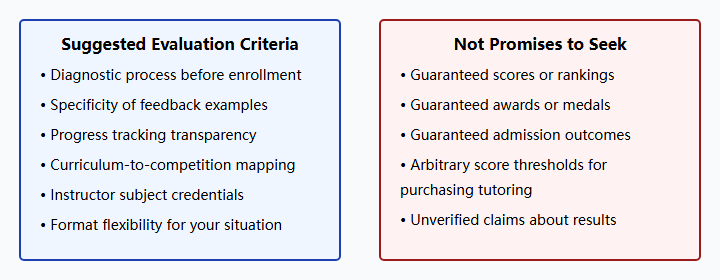
This distinction matters because the coaching market often blurs what providers can control (their teaching, materials, feedback systems) with what they cannot (examination outcomes dependent on student effort, question difficulty variation, and competition conditions). Focus your evaluation on process quality and transparency, not outcome guarantees.
The BBO review and reflection strategies article offers additional perspective on how to use practice performance data constructively, whatever support format you choose.
About Hanlin’s Approach (Illustrative, Not Exclusive)
To ground this discussion in a concrete example, Hanlin organizes BBO preparation across seven modules: animal physiology, plant physiology, cell biology, genetics, animal behaviour, ecology, and evolution, with associated past problems for each. This modular structure allows some flexibility in targeting, though the specific format of delivery—whether comprehensive course, targeted sessions, or other arrangements—varies and should be confirmed directly.
Teacher Yu’s editorial role in developing these materials reflects subject-specific expertise, but no tutoring arrangement guarantees particular outcomes. The September 21, 2026 observations about curriculum transfer patterns remain relevant diagnostic starting points, not deterministic rules.
Final Considerations for 2027 Preparation
Preparation targeting 2027 competition participation should begin with realistic timeline planning. Always consult the official UK Biology Competitions website for current competition information.
This guide is independent coaching guidance, not affiliated with, endorsed by, or sponsored by UK Biology Competitions. Your preparation decisions should combine multiple information sources, including official materials, school guidance, and direct provider consultation.
Effective BBO tutoring selection ultimately depends on honest self-assessment, specific questions about feedback quality, and willingness to walk away from providers that cannot explain their process clearly. The preparation time before 2027 is finite; invest it in support structures that match your actual needs.
How do I know if I need full BBO tutoring or just targeted support?
Assess whether your primary obstacle is missing knowledge across multiple topic areas, or specific gaps in vocabulary, reasoning patterns, or exam pacing. Large foundational gaps typically require comprehensive course support, while concentrated difficulties in particular areas may respond to targeted tuition. Attempt past papers under timed conditions and analyze error patterns before deciding.
What should I ask a BBO tutoring provider before committing?
Ask what tuition includes (materials, live sessions, platforms), whether instruction is individual or group format, how feedback is delivered and by whom, how progress is tracked, and what the schedule and terms are. Request specific examples of feedback on student work. Avoid providers who guarantee scores, awards, or admission outcomes.
How can I tell if BBO tutoring feedback is high quality?
Quality feedback identifies specific error patterns, explains why they matter for scoring, connects errors to relevant practice materials, and tracks patterns over time. Poor feedback merely marks answers correct or incorrect without explanation, or offers generic encouragement without actionable next steps. Ask to see anonymized examples before enrolling.