
The Core Challenge: Validity vs. Narrative
In the British Biology Olympiad (BBO), students often encounter experimental scenarios where the described method sounds logical but cannot support the stated conclusion. The specific skill tested is distinguishing a fair comparison—where controls isolate the variable of interest—from a convincing story—where a plausible mechanism or correlation substitutes for rigorous control. This article works through two teaching illustrations that isolate this exact reasoning failure.
What Separates a Fair Comparison From a Convincing Story
A fair comparison requires that the experimental groups differ only in the single variable being tested, with all other conditions matched or controlled. A convincing story occurs when a biologically plausible mechanism or familiar pattern leads students to accept a conclusion even though the experimental design lacks the controls needed to justify it. The danger in BBO questions is that the convincing story often feels like sufficient evidence because it aligns with known biology. The critical skill is recognizing when the narrative has replaced the control.
Teaching Illustration 1: When Correct Design Hides a Missing Control
Scenario: A researcher tests whether a novel plant extract promotes root growth. Two groups of identical seedlings are grown:
- Group A: Water only
- Group B: Plant extract dissolved in warm water (40°C to aid solubility)
After two weeks, Group B shows 40% longer roots. The researcher concludes: “The plant extract stimulates root growth.”
The convincing story: Plant extracts often contain auxin-like compounds, so the mechanism is biologically plausible. The method mentions only water and extract, so students may assume a fair comparison exists. The narrative of “extract promotes growth” feels sufficiently supported.
The fair comparison failure: There is no process control—seedlings treated with water heated to 40°C and then cooled to room temperature. If the temperature excursion during preparation affects root growth (or alters water chemistry), the observed difference may be attributable to the preparation method, not the extract. The comparison is unfair because the groups differ by two variables (extract presence and heating history), not one.
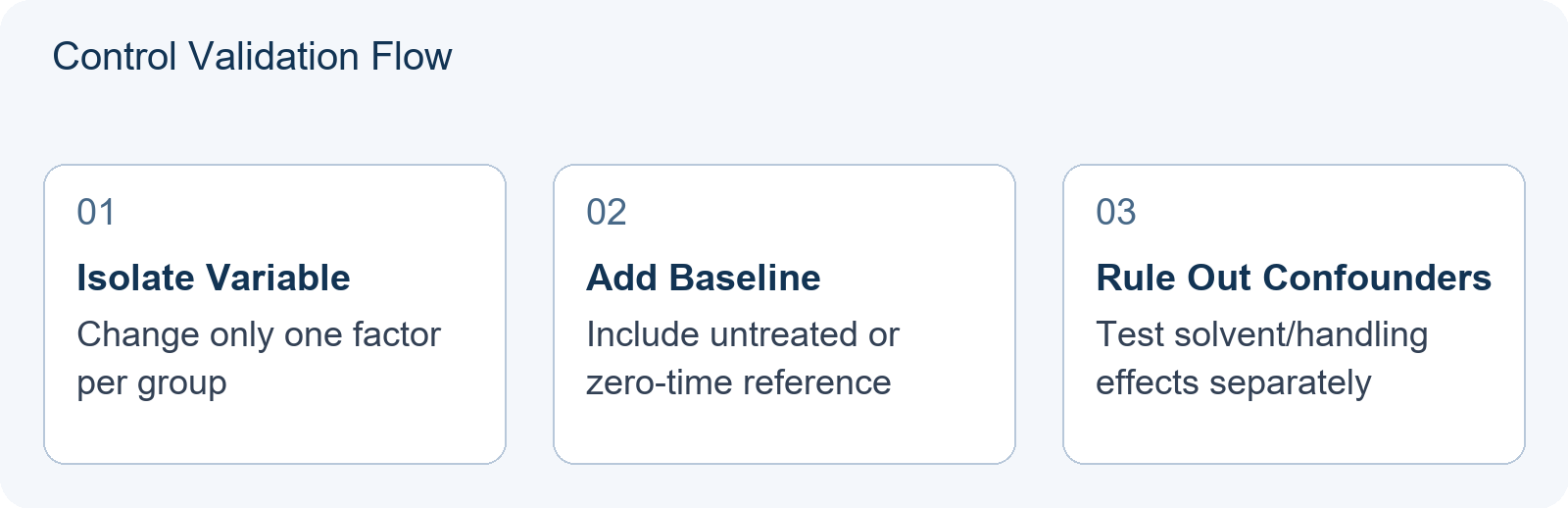
Correct design for a fair comparison: Add Group C: water heated to 40°C and cooled, matching the preparation of Group B. Only if Group B exceeds both Group A and Group C can the extract claim be supported. Without this control, the conclusion remains a convincing story.
Teaching Illustration 2: When Constant Conditions Create False Confidence
Scenario: An experiment tests whether light colour affects photosynthesis rate. Three setups use identical lamps at equal distance:
- Setup 1: Red light, 25°C, 20 cm from plant
- Setup 2: Blue light, 25°C, 20 cm from plant
- Setup 3: Green light, 25°C, 20 cm from plant
Setup 1 shows highest oxygen production. The conclusion states: “Red light is most efficient for photosynthesis.”
The convincing story: Chlorophyll absorbs red and blue light strongly, so red being optimal fits textbook knowledge. The temperature and distance are controlled, so the comparison seems fair. The narrative of “controlled conditions” feels like a fair comparison.
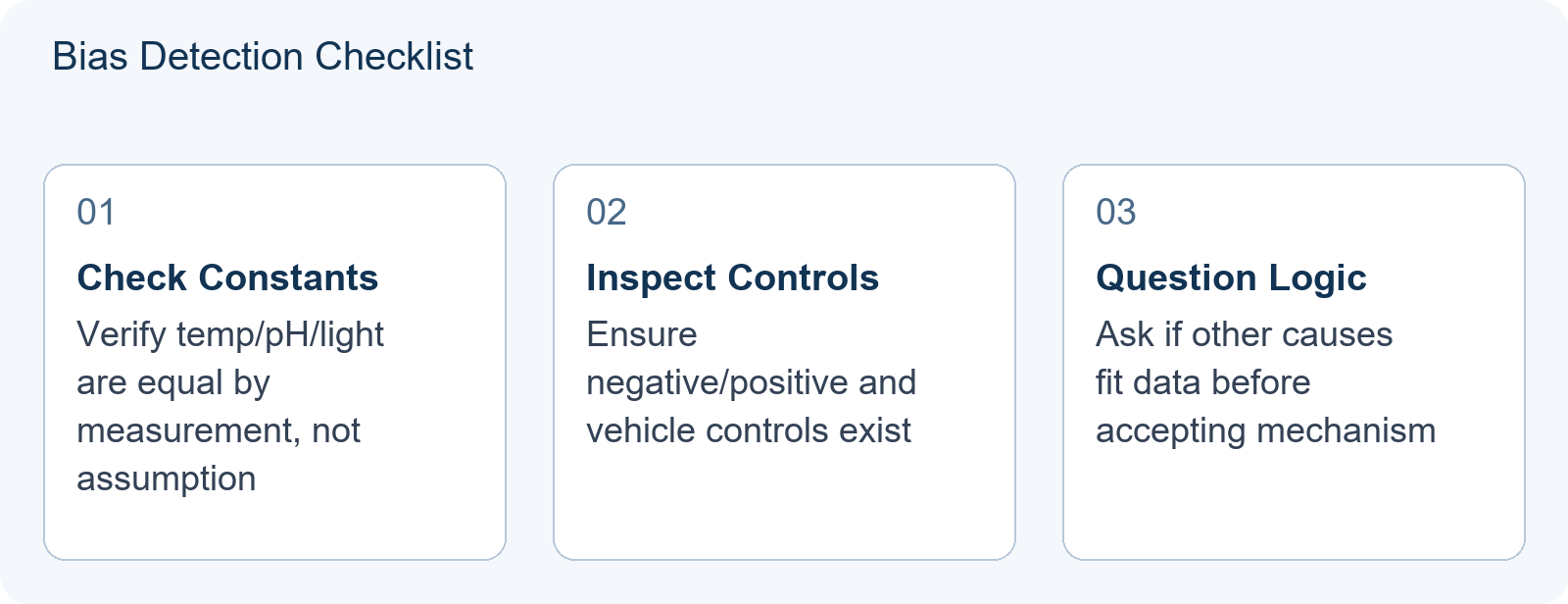
The fair comparison failure: The setups are identical in wavelength label but may differ in photon flux density (light intensity). Different-coloured LEDs or filters transmit unequal total energy. Without a light meter control—verifying equal photosynthetically active radiation (PAR) across all setups—the observed difference may reflect intensity, not wavelength. The convincing story of “controlled conditions” conceals an uncontrolled physical variable.
Correct design for a fair comparison: Measure PAR at the plant surface and adjust lamp output or distance so all setups deliver equal photon flux before the experiment begins. The fair comparison requires this verification; the convincing story skips it.
Diagnostic Table: Spotting the Convincing Story
| Warning Sign (Convincing Story) | What to Check (Fair Comparison) |
|---|---|
| Mechanism sounds biologically plausible | Does the control group match all physical conditions except the claimed variable? |
| “All other conditions were kept constant” stated without verification | Can the confounder be measured independently (e.g., light intensity, not just lamp distance)? |
| Single control group (e.g., water only) seems sufficient | Are there multiple uncontrolled variables (solvent, pH, temperature gradient from equipment)? |
Three-Step Practice Sequence
- Extract the Claim: Underline the exact causal statement in the question stem.
- List Hidden Variables: For each group, note every substance, condition, or piece of equipment that differs—not just the intended variable.
- Demand the Control: Ask what additional group or measurement would rule out each hidden variable. If none exists, the conclusion is unsupported regardless of how plausible it sounds.
For guidance on registration challenges, see BBO Registration 2027: What to Do When Your School Will Not or Cannot Enter You. For advice on selecting preparation support, refer to BBO Tutoring: Choose the Right Biology Support for Your 2027 Preparation. For strategies on using past papers effectively, review BBO Past Papers: How to Use Them When Answers Are Not Enough.
What to Demonstrate Next
The specific skill to practise is: given a BBO-style experimental description, identify one unstated assumption that makes the conclusion a convincing story rather than a fair comparison. Work through past paper questions by rewriting the method to include the missing control, then verify whether the conclusion still holds. A valid experiment must remain valid even when the mechanism sounds unlikely—and must fail when the control is absent, however plausible the biology appears.
Frequently Asked Questions
Why is a process control important in BBO questions?
It ensures the observed effect is due to the active agent, not the preparation method. Many BBO questions present experiments where the ‘control’ omits the preparation step entirely, making it impossible to distinguish treatment effects from handling effects.
Can I assume temperature is controlled if not stated?
No. In rigorous experimental design, you must verify if constants are explicitly maintained or measured. ‘Kept constant’ stated in a method is a claim, not evidence—check whether the apparatus described could maintain that constant.
How do I practise identifying missing controls under exam conditions?
For any BBO question describing an experiment, list every substance and condition in each group. Compare lists: any item that differs between groups but is not the stated independent variable represents a potential confounder requiring its own control.